

Littlest Boeing Makes Autonomous Flight | Aero-News Network
Aero-News Network
RSS icon RSS feed
podcast icon MP3 podcast
Subscribe Aero-News e-mail Newsletter Subscribe

Airborne Unlimited -- Most Recent Daily Episodes

Episode Date

Airborne-Monday

Airborne-Tuesday

Airborne-Wednesday Airborne-Thursday

Airborne-Friday

Airborne On YouTube

Airborne-Unlimited-12.08.25

AirborneNextGen-
12.09.25

Airborne-Unlimited-12.10.25

Airborne-FltTraining-12.04.25

AirborneUnlimited-12.05.25

AFE 2025 LIVE MOSAIC Town Hall (Archived): www.airborne-live.net

Fri, Jun 21, 2002

Littlest Boeing Makes Autonomous Flight

No; It's Not the 717 -- It's the ScanEagle UAV

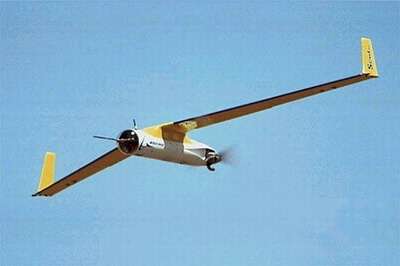
ScanEagle, a Boeing long-endurance unmanned aerial vehicle, successfully made its first autonomous flight Wednesday at the company's Boardman test facility in eastern Oregon. The UAV, built by The Insitu Group, took off via a pneumatic catapult and flew a pre-programmed course at a maximum altitude of 1,500 feet.

During the 45-minute flight, ScanEagle completed a number of test points using the Global Positioning System. The test team also demonstrated the ability to make real-time updates to the flight plan from the ground station. The UAV was retrieved using the patented SkyHook technique, in which the ScanEagle catches a rope hanging from a 30-foot-high pole.

"ScanEagle's milestone autonomous flight is a great example of the breadth of projects of our Unmanned Systems  organization," said Charlie Guthrie, Boeing Unmanned Systems director of rapid prototyping and advanced concepts. "We are melding Insitu's expertise and unique capabilities with the best of Boeing to provide an autonomous, low-cost, long-endurance UAV for a wide range of potential customers.

"Boeing has the proven expertise in all the areas essential to success in the unmanned market, and we foresee both commercial and military applications for this type of small, low-cost, long-endurance platform."

The four-foot long vehicle, which has a 10-foot wingspan and can fly up to 68 knots, was built using systems automation, integration, communications and payload technologies applicable to a variety of Boeing unmanned systems.

In February 2002, Boeing signed a 15-month agreement with Insitu to develop the ScanEagle UAV ("New UAV From Boeing, Insitu").

ScanEagle is based on Insitu's Seascan aircraft, a variant of which made the first UAV transatlantic flight, a 2,000-mile trip from Newfoundland to Scotland that used only 1.5 gallons of gasoline.

FMI: www.boeing.com

Advertisement

More News

ANN's Daily Aero-Term (12.08.25): Decision Altitude (DA)

Decision Altitude (DA) A specified altitude (mean sea level (MSL)) on an instrument approach procedure (ILS, GLS, vertically guided RNAV) at which the pilot must decide whether to >[...]

ANN's Daily Aero-Linx (12.08.25)

Aero Linx: T-34 Association, Inc. The T-34 Association was formed in July 1975 so that individuals purchasing then military surplus T-34As had an organization which would provide s>[...]

NTSB Final Report: Piper PA-31T3

As He Released The Brakes To Begin Taxiing, The Brake Pedals Went To The Floor With No Braking Action Analysis: The pilot reported that during engine start up, he applied the brake>[...]

Aero-News: Quote of the Day (12.08.25)

“Legislation like the Mental Health in Aviation Act is still imperative to hold the FAA accountable for the changes they clearly acknowledge need to be made... We cannot wait>[...]

Airborne-Flight Training 12.04.25: Ldg Fee Danger, Av Mental Health, PC-7 MKX

Also: IAE Acquires Diamond Trainers, Army Drones, FedEx Pilots Warning, DA62 MPP To Dresden Tech Uni The danger to the flight training industry and our future pilots is clear. Dona>[...]

blog comments powered by Disqus



Advertisement

Advertisement

Podcasts

Advertisement

© 2007 - 2025 Web Development & Design by Pauli Systems, LC

