
Moon Express Unveils Expanded Plan To Explore The Solar System | Aero-News Network
Aero-News Network
RSS icon RSS feed
podcast icon MP3 podcast
Subscribe Aero-News e-mail Newsletter Subscribe

Airborne Unlimited -- Most Recent Daily Episodes

Episode Date

Airborne-Monday

Airborne-Tuesday

Airborne-Wednesday Airborne-Thursday

Airborne-Friday

Airborne On YouTube

Airborne-Unlimited-12.08.25

AirborneNextGen-
12.09.25

Airborne-Unlimited-12.10.25

Airborne-AffordableFlyers-12.11.25

AirborneUnlimited-12.12.25

AFE 2025 LIVE MOSAIC Town Hall (Archived): www.airborne-live.net

Fri, Jul 14, 2017

Moon Express Unveils Expanded Plan To Explore The Solar System

Developing A New Family Of Spacecraft For Low-Cost Space Exploration

Moon Express, one of the competitors in the Google Lunar X Prize program, has unveiled plans to build a new family of spacecraft that it says will reach from the Moon to Mars and beyond.

Space.com reports that the company's agreement with Rocket Labs, which is developing the Electron booster that will propel the Moon Express lander to the Moon in hopes of claiming the $20 million GLXP award, covers up to five launches. Following the initial mission, Moon Express has scheduled a launch in 2019 that would establish a robotic research base near the lunar south pole. In 2020, Moon Express hopes to mount the first commercial mission to return a lunar sample to Earth.

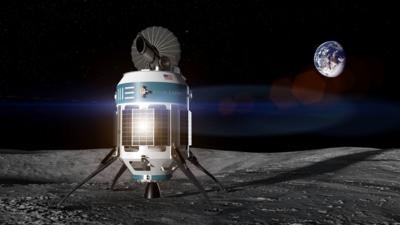
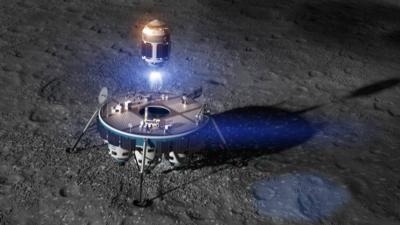
The central piece of hardware is a single engine lander dubbed MX-1, which will be flown on the GLXP mission. Moon express says it plans to mass-produce the lander and sell it as a lunar explorer, but also serve as the basis for larger and more capable spacecraft, which 1t calls the MX-2, MX-5 and MX-9. They will combine multiple MX-1 units into a single package of two, five and nine spacecraft to boost capacity. The MX-5 and MX-9 will be configured to return samples to Earth.

In a news conference Wednesday, Moon Express CEO and co-founder Bob Richards said these larger spacecraft could be capable of reaching Venus or Mars, or perhaps further into the solar system.

Richards said that the system has the potential to cut the cost of space exploration significantly. The company has estimated that the MX-1 and Electron booster could put the cost of a Moon mission at less than $10 million.

(Images courtesy of Moon Express Facebook page. Top: MX-1. Bottom: MX-9)

FMI: Original Report, www.moonexpress.com

Advertisement

More News

Aero-News: Quote of the Day (12.11.25)

"The owners envisioned something modern and distinctive, yet deeply meaningful. We collaborated closely to refine the flag design so it complemented the aircraft’s contours w>[...]

ANN's Daily Aero-Term (12.11.25): Nonradar Arrival

Nonradar Arrival An aircraft arriving at an airport without radar service or at an airport served by a radar facility and radar contact has not been established or has been termina>[...]

Classic Aero-TV: David Uhl and the Lofty Art of Aircraft Portraiture

From 2022 (YouTube Edition): Still Life with Verve David Uhl was born into a family of engineers and artists—a backdrop conducive to his gleaning a keen appreciation for the >[...]

Airborne-NextGen 12.09.25: Amazon Crash, China Rocket Accident, UAV Black Hawk

Also: Electra Goes Military, Miami Air Taxi, Hypersonics Lab, MagniX HeliStrom Amazon’s Prime Air drones are back in the spotlight after one of its newest MK30 delivery drone>[...]

Airborne 12.05.25: Thunderbird Ejects, Lost Air india 737, Dynon Update

Also: Trailblazing Aviator Betty Stewart, Wind Farm Scrutiny, Chatham Ban Overturned, Airbus Shares Dive A Thunderbird pilot, ID'ed alternately as Thunderbird 5 or Thunderbird 6, (>[...]

blog comments powered by Disqus



Advertisement

Advertisement

Podcasts

Advertisement

© 2007 - 2025 Web Development & Design by Pauli Systems, LC

