

NZ Air Force Medevacs Three Americans From Antarctica | Aero-News Network
Aero-News Network
RSS icon RSS feed
podcast icon MP3 podcast
Subscribe Aero-News e-mail Newsletter Subscribe

Airborne Unlimited -- Most Recent Daily Episodes

Episode Date

Airborne-Monday

Airborne-Tuesday

Airborne-Wednesday Airborne-Thursday

Airborne-Friday

Airborne On YouTube

Airborne-Unlimited-12.08.25

AirborneNextGen-
12.02.25

Airborne-Unlimited-12.03.25

Airborne-FltTraining-12.04.25

AirborneUnlimited-12.05.25

AFE 2025 LIVE MOSAIC Town Hall (Archived): www.airborne-live.net

Sat, Aug 09, 2025

NZ Air Force Medevacs Three Americans From Antarctica

Risked Subzero Temps, Total Darkness To Rescue McMurdo Station Staff

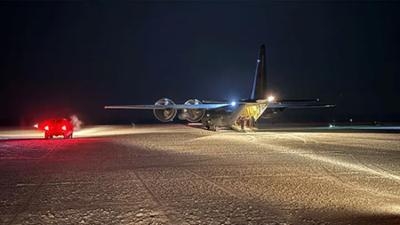
The New Zealand Air Force conducted a medevac operation lasting nearly 20 hours to rescue three Americans from McMurdo Station in Antarctica after they were unable to receive adequate treatment by on-site medical staff.

The U.S. National Science Foundation requested the medevac for the three individuals, one of whom required urgent care. The other two also needed care and were evacuated as a precaution.

Air Commodore Andy Scott, head of the air component for New Zealand, said mid-winter flights to  Antarctica are among the most challenging missions because of rapidly shifting weather conditions, extreme cold, and landing on ice in total darkness.

He said, "The crew can only attempt the flight after detailed analysis of the weather and airfield state. The United States Antarctic Program Winter Team must physically create the runway before we can depart by ensuring the ice is groomed and suitable for landing.”

"Although they determine it is safe, it's still an extremely challenging environment to fly in on Night Vision Goggles due to the extreme weather conditions, which are highly changeable at this time of year and makes accurate forecasting a challenge. This, coupled with there being no airfields available to divert to once the aircraft is past a certain point south adds to the risk, so these missions are not taken lightly,” he added.

The aircraft was pre-positioned from Auckland to Christchurch on Sunday August 3, and the Go decision was made when a weather window opened on Tuesday to fly to McMurdo. After landing in -11o F on the ice runway, the aircraft’s engines were kept running to prevent freezing during the refueling.

Melissa Sweeney, the U.S. Chargé d’Affaires to New Zealand, praised the operation as flawless, saying, "We are so very grateful. Our Kiwi partners didn’t hesitate to undertake this mission in one of the most unforgiving environments on Earth. Their skill and readiness are truly world-class."

FMI:  www.nsf.gov/

Advertisement

More News

Aero-News: Quote of the Day (12.07.25)

“This vote sends an undeniable message to Air Transat management: We are unified, resolute, and have earned a contract that reflects today’s industry standards, not the>[...]

ANN's Daily Aero-Linx (12.07.25)

Aero Linx: Beech Aero Club The Beech Aero Club (BAC) is the international type club for owners and pilots of the Beech Musketeer aircraft and its derivatives, the Sport, Super, Sun>[...]

NTSB Final Report: Lafferty Jack Sea Rey

While Landing In The River, The Extended Landing Gear Contacted The Water And The Airplane Nosed Over, Resulting In Substantial Damage Analysis: The pilot of the amphibious airplan>[...]

Classic Aero-TV: The B29 SuperFortress ‘Doc’ - History in Flight

From 2022 (YouTube Edition): Carrying the Legacy of The B-29 For Generations to Come We had a chance to chat with the Executive Director of B-29 Doc, Josh Wells, during their stop >[...]

Airborne 12.08.25: Samaritan’s Purse Hijack, FAA Med Relief, China Rocket Fail

Also: Cosmonaut Kicked Out, Airbus Scales Back, AF Silver Star, Russian A-60 Clobbered A Samaritan’s Purse humanitarian flight was hijacked on Tuesday, December 2, while atte>[...]

blog comments powered by Disqus



Advertisement

Advertisement

Podcasts

Advertisement

© 2007 - 2025 Web Development & Design by Pauli Systems, LC

