Alphabet Soup for the Warrior’s Soul
General Atomics Aeronautical Systems has recently conducted live, tactical, air combat maneuvers utilizing Artificial Intelligence (AI) pilots to control a company-owned MQ-20 Avenger Unmanned Aircraft System (UAS).
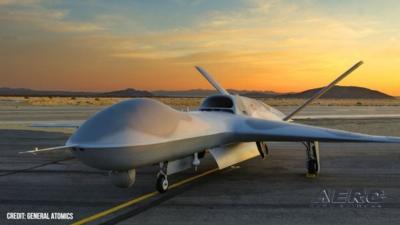
Collaborative maneuvers between human and AI pilots were conducted using General Atomics’s Live, Virtual, Constructive (LVC) Collaborative Combat Aircraft (CCA) ecosystem over a Low Earth Orbit (LEO) satellite communication (SATCOM) provider’s Internet Protocol (IP)-based Mission Beyond Visual Line of Sight (BVLOS) datalink. The LEO SATCOM connection was also used to rapidly retrain and redeploy AI pilots while the MQ-20 was airborne, thereby demonstrating General Atomics’s ability to update AI pilots within minutes.
General Atomics is an American energy and defense concern specializing in the research, development, and fielding of technologies germane to nuclear fission and nuclear fusion energy. The company also produces remotely operated surveillance aircraft—including the ubiquitous MQ-9 Reaper—as well as airborne sensors and advanced electric, electronic, wireless, and laser technologies.
The April maneuvers marked the first deployment of an Unmanned Combat Aerial Vehicle (UCAV) platform controlled by dint of a data connection made via an LEO SATCOM provider. To accomplish the feat, General Atomics engineers employed two L3Harris Technologies RASOR Multi-Functional Processors (MFPs)—one that housed a transceiver card and another that controlled the BVLOS Active Electronically Scanned Array (AESA). The test aircraft was outfitted with a Ball Aerospace BVLOS AESA system, capable of full duplex operation. The demonstration highlighted General Atomics’s commitment to operationalizing CCA by fusing innovative future warfare technologies, such as the company’s AI pilots and LVC ecosystem, and L3Harris and Ball Aerospace BVLOS datalink solutions.

General Atomics senior director of advanced programs Michael Atwood stated: “The flight demonstrated General Atomics’s unmatched ability to fly autonomy on real, tactically relevant, unmanned combat aerial vehicles. It displayed effective BVLOS Command and Control through the collaboration between three defense primes. This showcases our rapidly maturing CCA mission system suite and moves us one step closer to providing this revolutionary capability to the warfighter.”
General Atomics leveraged its end-to-end CCA ecosystem for the flight—which itself fused third-party capabilities, human-on-the-loop control, and autonomy to enable effective human-machine teaming for 21st Century conflicts. Operator commands were captured via Hands On Throttle-And-Stick (HOTAS) controls and were sent via LEO SATCOM to AI pilots running Reinforcement Learning (RL) algorithms. AI pilots autonomously tracked and maneuvered around dynamically, and updated entities specified via HOTAS. Operators were provided updates from AI pilots on a cockpit Heads-Up Display (HUD) and could dynamically re-task via HOTAS as the mission evolved. In addition, data from agent performance was collected and sent to the ground where agents were retrained to improve performance, then redeployed via LEO SATCOM in matters of minutes.
The exercise occasioned a continuation of General Atomics’s ongoing series of technology insertion and autonomous flights performed using internal research and development funding to prove-out important concepts for UAS.



 NTSB Final Report: Patriot Aircraft LLC CX1900A


 See All