Sat, Jul 29, 2023
Heat-Sensitive Metallurgy Allows for Retractable, Simple Vortex Generators
Normally vortex generators have always been welded onto whatever aerodynamic surface requires their surface. Yet, these little aero-rakes are normally only required for very specific modes of a given flight, such as low speed.
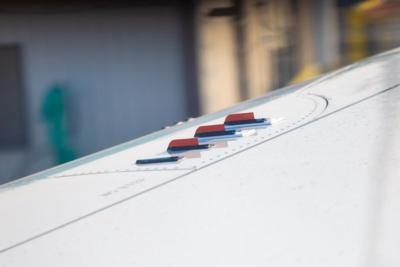
During the rest of the flight regime, the devices simply generate drag. Of course, that drag impacts fuel efficiency. If, however, the vortex generators could be retracted to any degree, that drag could largely be reduced. NASA is showing off a unique and passive system for self-retracting vortex generators at Airventure 2023. The basics of this device are demonstrated in a small model of a wing section in the NASA pavilion. This very simple device stands as a vortex generator when at low altitude. But, as the aircraft climbs to higher altitudes it folds shut. It does so automatically and without external power. What makes these retractable vortex generators function is a shape memory alloy developed by NASA. These alloys have been developed in a NASA laboratory through mixing specific types of metals together using special machinery. Once created, the researchers can “train” the alloy by forming it into a desired shape at a given temperature. Each time the alloy returns to that
temperature, it will return to that shape. When a strand of that alloy is used to move the fin of a vortex generator it gains a new, and very NASA name: the “Shape Memory Alloy Reconfigurable Technology Vortex Generator,” SMARTVG.
What makes the system work is the fact that near-the-ground temperatures are often far higher than they are at cruising flight altitudes. So, the alloy is twisted and trained to support the vortex generator fin in the up position at those temperatures. Then it is trained to twist and fold the fin down in the extreme cold of the upper atmosphere.
In that basic configuration, the system is completely passive. However, in extreme winter flying the system can be fooled into remaining retracted. Thus, a pilot-controlled warming system will need to be developed to augment the once-passive system.
This system was tested in a small form in 2019 and in October 2022. NASA partnered with Boeing aboard their 777-200 ecoDemonstrator and flew a sample SMARTVG. The early 2019 flights showed that the passive system worked as advertised. The 2022 flights tested the heating system with good cold weather results. Nasa stated that there is still more flight testing data ahead before they can declare the system to be operational, but the initial tests looked good.
More News
Decision Altitude (DA) A specified altitude (mean sea level (MSL)) on an instrument approach procedure (ILS, GLS, vertically guided RNAV) at which the pilot must decide whether to >[...]
Aero Linx: T-34 Association, Inc. The T-34 Association was formed in July 1975 so that individuals purchasing then military surplus T-34As had an organization which would provide s>[...]
As He Released The Brakes To Begin Taxiing, The Brake Pedals Went To The Floor With No Braking Action Analysis: The pilot reported that during engine start up, he applied the brake>[...]
“Legislation like the Mental Health in Aviation Act is still imperative to hold the FAA accountable for the changes they clearly acknowledge need to be made... We cannot wait>[...]
Also: IAE Acquires Diamond Trainers, Army Drones, FedEx Pilots Warning, DA62 MPP To Dresden Tech Uni The danger to the flight training industry and our future pilots is clear. Dona>[...]



 ANN's Daily Aero-Term (12.08.25): Decision Altitude (DA)


 See All