

NTSB: Power Line Survey Results In Wire Strike | Aero-News Network
Aero-News Network
RSS icon RSS feed
podcast icon MP3 podcast
Subscribe Aero-News e-mail Newsletter Subscribe

Airborne Unlimited -- Most Recent Daily Episodes

Episode Date

Airborne-Monday

Airborne-Tuesday

Airborne-Wednesday Airborne-Thursday

Airborne-Friday

Airborne On YouTube

Airborne-Unlimited-12.01.25

AirborneNextGen-
12.02.25

Airborne-Unlimited-12.03.25

Airborne-AffordableFlyers-11.20.25

AirborneUnlimited-11.21.25

LIVE MOSAIC Town Hall (Archived): www.airborne-live.net

Mon, Dec 20, 2010

NTSB: Power Line Survey Results In Wire Strike

Airframe Wire Cutter Appears To Have Helped Avoid More Serious Damage

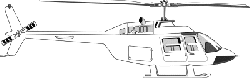
It may not sound like a glorious job... but powerline survey has its share of risks and rewards. In the case of an errant Bell 206, the risks exceeded the rewards on December 10th as the helo hit the stats line atop the powerline. Despite damage to the airframe and rotors, the pilot was able to get the bird safely to the ground... whew...

NTSB Identification: ERA11LA083
Nonscheduled 14 CFR Part 135: Air Taxi & Commuter
Accident occurred Friday, December 10, 2010 in Isom, KY
Aircraft: BELL 206B, registration: N263CH
Injuries: 1 Minor, 2 Uninjured.

This is preliminary information, subject to change, and may contain errors. Any errors in this report will be corrected when the final report has been completed.

On December 10, 2010, about 1150 eastern standard time, a Bell 206B, N263CH, performed an emergency landing next to a roadway after impacting electrical wires near Isom, Kentucky. The helicopter departed from a remote location near Louisa, Kentucky, about 1030, for the local aerial power line observation flight. Visual meteorological conditions prevailed and no flight plan was filed. The certificated airline transport pilot received minor injuries and the two passengers were not injured. The helicopter sustained substantial damage to the support post around the pilot side door and damage to the fuselage on the front and pilot side of the helicopter. The flight was operated under the provisions of 14 Code of Federal Regulations Part 135.

According to the pilot, he was performing a power line survey flight for charter and also had employees from the power company onboard. The helicopter was cruising about 60 to 70 knots when it impacted the static line on top of the powerline. He reported that he never lost control of the helicopter, but put it down as soon as he could in a parking lot, which was about one-quarter mile from the wire strike. He further stated that prior to the wire strike; there were no mechanical anomalies with the helicopter.

The Federal Aviation Administration inspector that responded to accident location reported that the helicopter impacted a 3/8 inch diameter, 7-strand wire. A few of the strands were severed by the wire cutter located below the main rotor mast, and a 12 inch piece of the strand remained in the wire cutter. One main rotor blade exhibited damage approximately 1 foot from the rotor tip. Control continuity was confirmed to all flight controls and no damage was observed to the landing gear.

FMI: www.ntsb.gov

Advertisement

More News

ANN's Daily Aero-Term (12.01.25): Convective SIGMET

Convective SIGMET A weather advisory concerning convective weather significant to the safety of all aircraft. Convective SIGMETs are issued for tornadoes, lines of thunderstorms, e>[...]

ANN's Daily Aero-Linx (12.01.25)

Aero Linx: United Flying Octogenarians WELCOME to a most extraordinary group of aviators, the United Flying Octogenarians (UFO). Founded in 1982 with just a handful of pilots, we h>[...]

NTSB Final Report: Remos Aircraft GmbH Remos GX

Pilot’s Decision To Attempt Takeoff With Frost Covering The Airplane’s Wings Analysis: The pilot of the light sport airplane was preparing to depart for a cross-country>[...]

Aero-News: Quote of the Day (12.02.25)

“We’ve paid for the cable line’s repair for the customer and have apologized for the inconvenience this caused them...” Source: Some followup info from an A>[...]

ANN's Daily Aero-Term (12.02.25): Coupled Approach

Coupled Approach An instrument approach performed by the aircraft autopilot, and/or visually depicted on the flight director, which is receiving position information and/or steerin>[...]

blog comments powered by Disqus



Advertisement

Advertisement

Podcasts

Advertisement

© 2007 - 2025 Web Development & Design by Pauli Systems, LC

