

10 Years Later, Record High Altitude Parachute Jump Still Stands | Aero-News Network
Aero-News Network
RSS icon RSS feed
podcast icon MP3 podcast
Subscribe Aero-News e-mail Newsletter Subscribe

Airborne Unlimited -- Most Recent Daily Episodes

Episode Date

Airborne-Monday

Airborne-Tuesday

Airborne-Wednesday Airborne-Thursday

Airborne-Friday

Airborne On YouTube

Airborne-Unlimited-09.08.25

AirborneNextGen-
09.09.25

Airborne-Unlimited-09.10.25

Airborne-AffordableFlyers-09.11.25

AirborneUnlimited-09.12.25

Wed, Oct 30, 2024

10 Years Later, Record High Altitude Parachute Jump Still Stands

Alan Eustace’s Three FAI Records Remain Unbroken

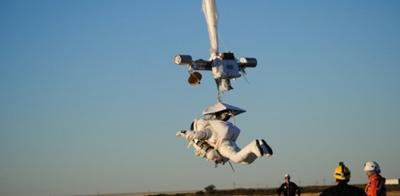
On October 24, 2014, 57-year-old Alan Eustace wore a specially designed suit to protect him from temperature and pressure changes as he ascended beneath a 120 meter tall helium balloon on his way to setting three World Air Sports Federation (FAI) records that still remain intact.

It took Eustace a little over two hours to reach the altitude where the balloon stabilized at nearly the outer edge of the stratosphere. He and his Mission Control team began the countdown to release him.

The first FAI record was set upon his release: Exit Altitude 41,422 meters (135,899 feet).

After just 35 seconds Eustace broke the speed of sound, and after 51 seconds he reached his second FAI record: Maximum Vertical Speed With Drogue was a face-melting 1,320 kph (820 mph).

The drogue was, and remains, an essential element of parachute jumps, especially at high altitudes because a drogue adds stability. It prevents entry into a high-speed spin which might prove fatal.

Eustace sailed down in free fall to this third record: Distance of Fall With Drogue 37,623 meters (123,631 feet).

He landed 4 minutes and 27 seconds after release, a little over 100 km from his launch point.

About his ascent, Eustace said it was “peaceful” and, “You can see the darkness of space, the curvature of the Earth, the fragile planet below..."

About his free fall, “I had zero sensation of speed... It felt like I was falling in a void. I had no sense of gravity."

He didn’t hear his sonic boom, in fact all he heard was his breathing.

Then, "The moment you hear sound, it means you're slowing down." His canopy opened. "That's the moment I knew it was over."

A good skydiving friend joined him during his final descent and upon landing Eustace was asked how he felt and said, “Kind of detached. Like it was over. And kind of tired. And hungry!"

He had awoken very early that morning and had not eaten prior to the flight, only inhaling copious amounts of oxygen.

FMI:  www.fai.org/

Advertisement

More News

NTSB Prelim: Lancair NLA-275-FR-C

About 2132 And At 11,800 Ft MSL, The Airplane Began A Rapid Right Spiraling Descent On August 18, 2025, about 2133 central daylight time, a Lancair NLA-275-FR-C airplane, N345LA, w>[...]

ANN's Daily Aero-Linx (09.12.25)

Aero Linx: The Collings Foundation The Collings Foundation is a non-profit, Educational Foundation (501(c)3), founded in 1979. The purpose of the Foundation is to preserve and exhi>[...]

Aero-News: Quote of the Day (09.12.25)

"This first FAA certification enables us to address the pilot shortage crisis with modern training solutions. Flight schools need alternatives to aging fleets with 40-year-old desi>[...]

ANN's Daily Aero-Term (09.12.25): North Atlantic High Level Airspace (NAT HLA)

North Atlantic High Level Airspace (NAT HLA) That volume of airspace (as defined in ICAO Document 7030) between FL 285 and FL 420 within the Oceanic Control Areas of Bodo Oceanic, >[...]

Aero-News: Quote of the Day (09.13.25)

“HITRON embodies the Coast Guard’s spirit of innovation and adaptability. From its humble beginnings as a prototype program, it has evolved into a vital force in our co>[...]

blog comments powered by Disqus



Advertisement

Advertisement

Podcasts

Advertisement

© 2007 - 2025 Web Development & Design by Pauli Systems, LC

