
OSIRIS-REx Return Investigation Complete | Aero-News Network
Aero-News Network
RSS icon RSS feed
podcast icon MP3 podcast
Subscribe Aero-News e-mail Newsletter Subscribe

Airborne Unlimited -- Most Recent Daily Episodes

Episode Date

Airborne-Monday

Airborne-Tuesday

Airborne-Wednesday Airborne-Thursday

Airborne-Friday

Airborne On YouTube

Airborne-SpecialEpisode-12.15.25

AirborneNextGen-
12.16.25

Airborne-Unlimited-12.10.25

Airborne-AffordableFlyers-12.11.25

AirborneUnlimited-12.12.25

AFE 2025 LIVE MOSAIC Town Hall (Archived): www.airborne-live.net

Fri, Dec 08, 2023

OSIRIS-REx Return Investigation Complete

Drogue Failure Result of "Inconsistent Wiring Label Definitions"

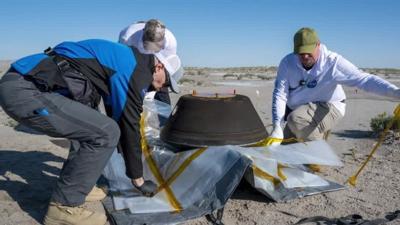
A recent return mission carrying samples from the asteroid Bennu raised eyebrows at NASA when a drogue chute failed to deploy during the landing sequence.

During the return of the OSIRIS-REx mission, a drogue was supposed to deploy at 100,000 feet to stabilize and slow the capsule during a 5-minute descent down to 10,000 feet. Instead, the signal triggered a different reaction at 100,000', jettisoning the parachute prior to it even deploying. With its retention cord cut, the main parachute was forced to take the entire deceleration load on its own. Luckily, NASA says, the margins as designed were sufficient to protect the Bennu sample.

The culprit for the drogue mishap turns out to be inconsistent verbiage in the use of "main" between two different subsystems. "On the signal side, “main” meant the main parachute. In contrast, on the receiver side “main” was used as a reference to a pyrotechnic that fires to release the parachute canister cover and deploy the drogue. Engineers connected the two mains, causing the parachute deployment actions to occur out of order," said the NASA investigation.

From here, the system will be tested again in situ, using the same hardware that misfired on the OSIRIS mission. The sample remains safely nestled in "one of the glove boxes inside the Johnson Space Center", awaiting the curation team's attention. Once complete, the equipment can be turned over for testing.

FMI: www.nasa.gov

Advertisement

More News

Aero-News: Quote of the Day (12.18.25)

“These new aircraft strengthen our ability to respond quickly, train effectively and support communities nationwide. Textron Aviation has been a steadfast supporter in helpin>[...]

Classic Aero-TV: Viking Twin Otter 400--Bringing the DHC-6 Back Into Production

From 2011 (YouTube Edition): Rugged, Legendary, STOL Twin Makes A Comeback The de Havilland Twin Otter is an airplane with a long history, and it gained a reputation as a workhorse>[...]

NTSB Final Report: Rans Employee Flying Club Rans S-6ES Coyote II

A Wind Gust Lifted The Right Wing And The Airplane Turned To The Left Analysis: The pilot was departing from a 2,395-ft-long by 50-ft-wide turf runway. The pilot reported that afte>[...]

ANN FAQ: Submit a News Story!

Have A Story That NEEDS To Be Featured On Aero-News? Here’s How To Submit A Story To Our Team Some of the greatest new stories ANN has ever covered have been submitted by our>[...]

ANN's Daily Aero-Term (12.18.25): Braking Action Advisories

Braking Action Advisories When tower controllers receive runway braking action reports which include the terms “medium," “poor," or “nil," or whenever weather con>[...]

blog comments powered by Disqus



Advertisement

Advertisement

Podcasts

Advertisement

© 2007 - 2025 Web Development & Design by Pauli Systems, LC

