
Pentagon Puts Hold On Osprey Flights Again | Aero-News Network
Aero-News Network
RSS icon RSS feed
podcast icon MP3 podcast
Subscribe Aero-News e-mail Newsletter Subscribe

Airborne Unlimited -- Most Recent Daily Episodes

Episode Date

Airborne-Monday

Airborne-Tuesday

Airborne-Wednesday Airborne-Thursday

Airborne-Friday

Airborne On YouTube

Airborne-Unlimited-12.01.25

AirborneNextGen-
12.02.25

Airborne-Unlimited-11.19.25

Airborne-AffordableFlyers-11.20.25

AirborneUnlimited-11.21.25

LIVE MOSAIC Town Hall (Archived): www.airborne-live.net

Fri, Dec 13, 2024

Pentagon Puts Hold On Osprey Flights Again

Issues With Weakened Metal Parts In Near-Crash Cited Again

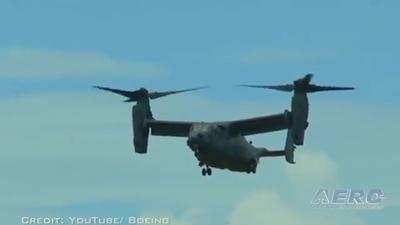
The military is once again pausing operations of the Bell Boeing V-22 Osprey after a near-crash at Cannon Air Force Base in Clovis, New Mexico, on November 20, 2024.

Similar to a fatal accident in Japan in December 2023, contaminated metal parts failed, leading to an engine failure. In this latest incident, the crew received warnings shortly after takeoff and were quickly able to put the aircraft back on the ground without any injuries.

An initial review of the part involved in this incident showed that weakened metal may have played a role, but in a different part of the powertrain than the Japan accident.

On recommendation from Naval Air Systems Command (NAVAIR), Lt. Gen. Michael Conley, commander of the Air Force Special Operations Command, directed a pause on all Osprey training flights “to allow time and space for us to understand what happened.”

While this investigation is still under way, the metal that failed in the Japan crash, X-53 VIMVAR, had multiple inclusions, or contaminants caused by foreign material getting into the metal during the manufacturing process. The contaminants cause microscopic weak spots and can lead to fatigue cracking and eventual failure of the part.

Since the Japan accident, Bell Flight, which builds the transmission systems and assembles the Osprey at its Amarillo, Texas, facility, have been pressing for ways to make the metal stronger and more reliable.

FMI:  www.navair.navy.mil/

Advertisement

More News

ANN's Daily Aero-Term (12.01.25): Convective SIGMET

Convective SIGMET A weather advisory concerning convective weather significant to the safety of all aircraft. Convective SIGMETs are issued for tornadoes, lines of thunderstorms, e>[...]

ANN's Daily Aero-Linx (12.01.25)

Aero Linx: United Flying Octogenarians WELCOME to a most extraordinary group of aviators, the United Flying Octogenarians (UFO). Founded in 1982 with just a handful of pilots, we h>[...]

NTSB Final Report: Remos Aircraft GmbH Remos GX

Pilot’s Decision To Attempt Takeoff With Frost Covering The Airplane’s Wings Analysis: The pilot of the light sport airplane was preparing to depart for a cross-country>[...]

Aero-News: Quote of the Day (12.02.25)

“We’ve paid for the cable line’s repair for the customer and have apologized for the inconvenience this caused them...” Source: Some followup info from an A>[...]

ANN's Daily Aero-Term (12.02.25): Coupled Approach

Coupled Approach An instrument approach performed by the aircraft autopilot, and/or visually depicted on the flight director, which is receiving position information and/or steerin>[...]

blog comments powered by Disqus



Advertisement

Advertisement

Podcasts

Advertisement

© 2007 - 2025 Web Development & Design by Pauli Systems, LC

