
President Bush Makes Carrier Landing | Aero-News Network
Aero-News Network
RSS icon RSS feed
podcast icon MP3 podcast
Subscribe Aero-News e-mail Newsletter Subscribe

Airborne Unlimited -- Most Recent Daily Episodes

Episode Date

Airborne-Monday

Airborne-Tuesday

Airborne-Wednesday Airborne-Thursday

Airborne-Friday

Airborne On YouTube

Airborne-Unlimited-12.01.25

AirborneNextGen-
12.02.25

Airborne-Unlimited-12.03.25

Airborne-AffordableFlyers-11.20.25

AirborneUnlimited-11.21.25

LIVE MOSAIC Town Hall (Archived): www.airborne-live.net

Fri, May 02, 2003

President Bush Makes Carrier Landing

Only President to Ever Catch a Wire

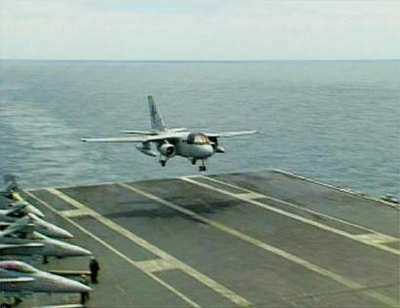
He couldn't have done it without Abraham Lincoln, whose name was on the ship, and he wasn't about to try it from the left seat, but the Commander-in-Chief's S-3B Viking caught the fourth wire (and you know the poor left seater is going to catch all kinds of crap over missing the three-wire...) on the flight deck of the USS Abraham Lincoln (CVN-72), and that put the fighter-pilot President into the history books.

At just after noon San Diego time on Thursday, that Viking, the second of a pair from the "Blue Wolves," greased the deck.

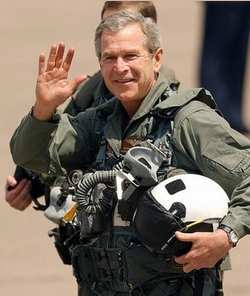
Although he has lately been relegated to the back seats of most aircraft, Mr. Bush, once an F-102  pilot in the Texas ANG, logged a little time on the short flight.

"Yes, I flew it. Yeah, of course, I liked it," he told the obviously clueless media, right after the flight.

In the Viking's two rear seats were another pilot and a Secret Service agent. His left-seater was Navy Cmdr. John Lussier of Orlando, Fla.

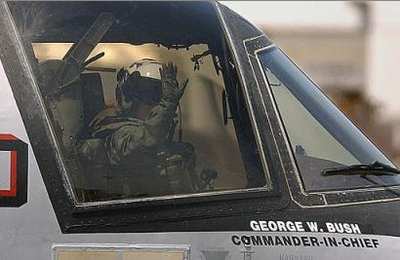
Appropriately titled under the windshield (on the right) were the words, "George W. Bush, Commander-in-Chief."

Earlier plans for the President to greet the Abraham Lincoln, which has been at sea for ten months, from an F/A-18 were stomped by the SS, which considered it too great a risk to have just one pilot, and no bodyguard, with the President.

The jet landing itself was deemed necessary because the ship's battle group was outside what the SS considers safe overwater helicopter range.

FMI: https://www.cvn72.navy.mil

Advertisement

More News

ANN's Daily Aero-Term (12.01.25): Convective SIGMET

Convective SIGMET A weather advisory concerning convective weather significant to the safety of all aircraft. Convective SIGMETs are issued for tornadoes, lines of thunderstorms, e>[...]

ANN's Daily Aero-Linx (12.01.25)

Aero Linx: United Flying Octogenarians WELCOME to a most extraordinary group of aviators, the United Flying Octogenarians (UFO). Founded in 1982 with just a handful of pilots, we h>[...]

NTSB Final Report: Remos Aircraft GmbH Remos GX

Pilot’s Decision To Attempt Takeoff With Frost Covering The Airplane’s Wings Analysis: The pilot of the light sport airplane was preparing to depart for a cross-country>[...]

Aero-News: Quote of the Day (12.02.25)

“We’ve paid for the cable line’s repair for the customer and have apologized for the inconvenience this caused them...” Source: Some followup info from an A>[...]

ANN's Daily Aero-Term (12.02.25): Coupled Approach

Coupled Approach An instrument approach performed by the aircraft autopilot, and/or visually depicted on the flight director, which is receiving position information and/or steerin>[...]

blog comments powered by Disqus



Advertisement

Advertisement

Podcasts

Advertisement

© 2007 - 2025 Web Development & Design by Pauli Systems, LC

