45-Year NASA Pioneer Set To Retire
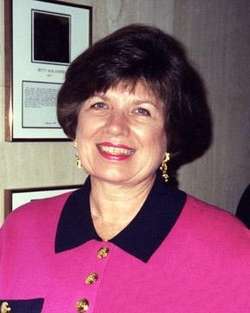 In the next few weeks, a
vital part of NASA will leave the space program. JoAnn Morgan is
retiring, after 45 years with the space agency. During her tenure,
she's seen the Kennedy Space Center evolve out of what was once the
Army Ballistic Missile Center. That was just after she arrived at
Cape Canaveral, a fresh-faced 18-year old girl on a summer college
internship. "I started work on a Monday," Ms. Morgan said in a
recent telephone interview with ANN. "On Friday, I was working on
my first launch." Young JoAnn stood out in the parking lot
measuring visual aspects of the launch. "They handed me a device
and told me I was part of the team."
In the next few weeks, a
vital part of NASA will leave the space program. JoAnn Morgan is
retiring, after 45 years with the space agency. During her tenure,
she's seen the Kennedy Space Center evolve out of what was once the
Army Ballistic Missile Center. That was just after she arrived at
Cape Canaveral, a fresh-faced 18-year old girl on a summer college
internship. "I started work on a Monday," Ms. Morgan said in a
recent telephone interview with ANN. "On Friday, I was working on
my first launch." Young JoAnn stood out in the parking lot
measuring visual aspects of the launch. "They handed me a device
and told me I was part of the team."
She never left her teammates. She was there on the good days
when launches went just right. She was there on the bad days, to
share the grief and start the process of rebuilding. But soon,
JoAnn will retire. She won't be there anymore.
JoAnn Morgan, Meet John Glenn (And Gus Grissom and Alan
Shepherd...)
Ms. Morgan was in from the very start of manned
flight. She knew and appreciated astronaut-pioneers like John
Glenn. She worked with him on the Mercury project when Glenn became
the first American to orbit the Earth. She worked with him again
decades later when Glenn flew on a space shuttle. "His mind is
still incredible," she recalls. She also worked with Gus
Grissom and remembers vividly the loss of his Mercury capsule,
Liberty Bell 7. The event stunned JoAnn and other workers
at the fledgling space agency. "Losing a spacecraft is a terrible
tragedy in our business," she said. Did Grissom pop the hatch,
causing the capsule to sink? "No," she said firmly. "I don't think
so." Grissom, she remembers, was an irascible pilot with a driving
dedication to perfection. "He was a nice guy," she said at first,
finding the right words to say in appreciation of a very tough
cookie. "He was crusty and grumpy, but I had a lot of respect for
Gus." She remembers his absolute dedication to the mission.
Homecoming
 She also remembers,
years later, standing at Port Canaveral as Liberty Bell 7,
covered in barnacles, was brought in after being rescued from the
depths of the Pacific Ocean. She saw it again after it was
restored. JoAnn Morgan was just as impressed with the recovery of
that bit of history as were we all.
She also remembers,
years later, standing at Port Canaveral as Liberty Bell 7,
covered in barnacles, was brought in after being rescued from the
depths of the Pacific Ocean. She saw it again after it was
restored. JoAnn Morgan was just as impressed with the recovery of
that bit of history as were we all.
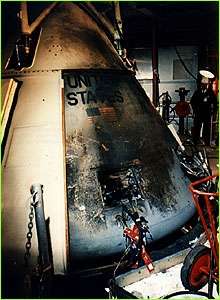
Her memories of Gus Grissom, sadly, don't end there.
Ms. Morgan continued to work NASA launches, specializing in
communications and data flow. She was working on the day Grissom
died in the fire that roared through the Apollo 1 capsule
as it was undergoing pre-flight testing. "Communications were
crappy," she said. "They didn't work with a flip." She worked on
the problem for endless hours until, just before she left for the
day, Grissom, Ed White and Roger Chafee climbed into the spacecraft
to conduct their part in the tests. "We didn't know the crew was
going to be out there. That made it even worse.
"We had already had numbers of missions where the vehicle blew
up or the trajectory went awry," she recalled sadly. "But this was
the first loss of a crew. It was hard on the whole team. And yet --
" here, she pauses remembering the steely determination that
developed nationwide after the fatal fire -- "it was a different
environment then. Everybody was with us. We just had to say what we
needed and we had it." With that sort of can-do attitude, NASA was
on the moon two years after the Apollo 1 tragedy.
Monday, in part two of JoAnn Morgan's story, she talks about
breaking the gender barrier at NASA, about the moon landing and the
disasters that destroyed both Challenger and
Columbia.



 ANN's Daily Aero-Term (12.13.25): Light Gun


 See All