
Boeing, Korean Air Announce Order For Five 777 Freighters | Aero-News Network
Aero-News Network
RSS icon RSS feed
podcast icon MP3 podcast
Subscribe Aero-News e-mail Newsletter Subscribe

Airborne Unlimited -- Most Recent Daily Episodes

Episode Date

Airborne-Monday

Airborne-Tuesday

Airborne-Wednesday Airborne-Thursday

Airborne-Friday

Airborne On YouTube

Airborne-Unlimited-12.01.25

AirborneNextGen-
12.02.25

Airborne-Unlimited-11.19.25

Airborne-AffordableFlyers-11.20.25

AirborneUnlimited-11.21.25

LIVE MOSAIC Town Hall (Archived): www.airborne-live.net

Sat, Feb 14, 2015

Boeing, Korean Air Announce Order For Five 777 Freighters

Package Valued At More Than $1.5 Billion

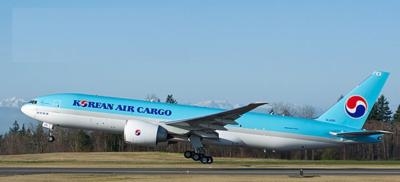
Boeing and Korean Air have finalized an order for five 777 Freighters. The order, valued at more than $1.5 billion at current list prices, will add further efficiency and reliability to Korean Air's all-Boeing freighter fleet.

As one of the world's largest cargo airlines, Korean Air currently operates an all-Boeing freighter fleet of 26 airplanes that includes 17 747-400 Freighters, five 747-8 Freighters and four 777 Freighters.

"We truly value our enduring partnership with Korean Air and we are pleased that they have selected the 777 Freighter to bolster their all-Boeing Freighter fleet," said Ihssane Mounir, senior vice president of NE Asia Sales, Boeing Commercial Airplanes. "This order further demonstrates Korean Air's commitment to excellence and will help the airline maintain its position as a leading global airline."

Korea's flag carrier currently operates 86 Boeing passenger airplanes and has unfilled orders for nearly 40 additional airplanes, including 12 777-300ERs, 10 747-8 Intercontinentals, 10 787-9 Dreamliners, two 747-8 Freighters and six 777 Freighters.

Boeing says the 777 Freighter is the world's longest range twin-engine freighter, capable of flying 4,900 nautical miles with a full payload at general cargo market densities. The airplane's range capability translates into significant savings for cargo operators: fewer stops and associated landing fees, less congestion at transfer hubs, lower cargo handling costs and shorter cargo delivery times.

According to the Boeing World Air Cargo Forecast, global air freight traffic is forecast to grow at an annual rate of 4.7 percent, doubling the cargo traffic over the next 20 years.

(Image provided by Boeing)

FMI: www.boeing.com

Advertisement

More News

ANN's Daily Aero-Term (12.01.25): Convective SIGMET

Convective SIGMET A weather advisory concerning convective weather significant to the safety of all aircraft. Convective SIGMETs are issued for tornadoes, lines of thunderstorms, e>[...]

ANN's Daily Aero-Linx (12.01.25)

Aero Linx: United Flying Octogenarians WELCOME to a most extraordinary group of aviators, the United Flying Octogenarians (UFO). Founded in 1982 with just a handful of pilots, we h>[...]

NTSB Final Report: Remos Aircraft GmbH Remos GX

Pilot’s Decision To Attempt Takeoff With Frost Covering The Airplane’s Wings Analysis: The pilot of the light sport airplane was preparing to depart for a cross-country>[...]

Aero-News: Quote of the Day (12.02.25)

“We’ve paid for the cable line’s repair for the customer and have apologized for the inconvenience this caused them...” Source: Some followup info from an A>[...]

ANN's Daily Aero-Term (12.02.25): Coupled Approach

Coupled Approach An instrument approach performed by the aircraft autopilot, and/or visually depicted on the flight director, which is receiving position information and/or steerin>[...]

blog comments powered by Disqus



Advertisement

Advertisement

Podcasts

Advertisement

© 2007 - 2025 Web Development & Design by Pauli Systems, LC

