Tue, Nov 01, 2022
You’ll Love the Way We Fly—Or Don’t
The pilots of Delta Airlines, represented by the Airline Pilots Association, International (ALPA), have voted overwhelmingly in favor of a strike-authorization ballot. Ninety-nine-percent of the over 96-percent of Delta pilots who participated in the vote authorized union leaders to call a strike, if necessary, to achieve a new contractual agreement with Delta Airlines—and with good reason.
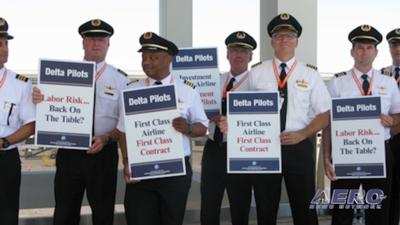
Delta pilots are working under contractual provisions—to include pay-rates and benefits—negotiated in 2016. Negotiations for a new labor agreement began in April 2019—nine-months prior to the amendable date of December 2019. Talks entered mediation in February 2020 and were paused in March 2020 for nearly two-years on account of the COVID-19 pandemic. Mediated talks resumed in January 2022—albeit to no avail.
Delta Master Executive Council chair Captain Jason Ambrosi states: “Today, Delta’s nearly 15,000 pilots sent a clear message to management that we are willing to go the distance to secure a contract that reflects the value we bring to Delta Airlines as frontline leaders and long-term stakeholders. Delta has rebounded from the pandemic and is poised to be stronger than ever, posting record revenues for the third-quarter. Meanwhile, our negotiations have dragged on for too long. Our goal is to reach an agreement, not to strike. The ball is in management’s court. It’s time for the company to get serious at the bargaining table and invest in the Delta pilots.”
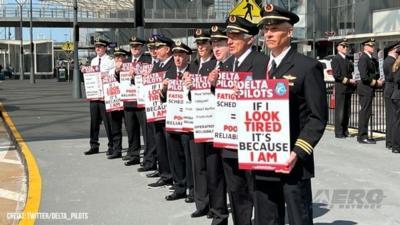
By U.S. federal law, labor contracts in the airline industry do not expire. Prior to the legal enactment of a strike, federal moderators must first determine that additional mediatory efforts would prove fruitless, and afford opposing parties opportunity to arbitrate contract disputes. In the event either side declines arbitration, it becomes incumbent on both parties to enter a thirty-day cooling off period, after which—as in the prevailing Delta instance—pilots and management may commence the complex rituals of saber-rattling, strong-arming, and head-thumping by which capitalist labor disputes are resolved—which is to say, a strike by the union or a lockout by the airline’s management.

The aforementioned lengthy and convoluted process renders airline workers’ strikes rare—the last pilot work-stoppage at a U.S. air-carrier having occurred in 2010, when Spirit Airline pilots struck over a dispute in pay and brought the airline’s flight operations to an utter and memorable halt. Whether or not the collective memory of Delta’s sitting management stretches back to 2010 remains to be seen. It is likely, however, that American Airlines’ recent offer to up its pilots’ pay by 19% over the next two-years may serve as a model for future talks around the ATL bargaining table.
More News
Aero Linx: Commercial Aviation Safety Team (CAST) Founded in 1997, the Commercial Aviation Safety Team (USCAST) has developed an integrated, data-driven strategy to reduce the comm>[...]
Land And Hold Short Operations Operations that include simultaneous takeoffs and landings and/or simultaneous landings when a landing aircraft is able and is instructed by the cont>[...]
We're Everywhere... Thanks To You! Even with the vast resources and incredibly far-reaching scope of the Aero-News Network, every now and then a story that should be reported on sl>[...]
Pilot’s Inadvertent Use Of The Landing Gear Control Handle Instead Of The Flaps Selector Switch During The Landing Rollout Analysis: The pilot reported that during the landin>[...]
Also: Cosmonaut Kicked Out, Airbus Scales Back, AF Silver Star, Russian A-60 Clobbered A Samaritan’s Purse humanitarian flight was hijacked on Tuesday, December 2, while atte>[...]



 ANN's Daily Aero-Linx (12.12.25)


 See All