

NASA Moves Shuttle Engines From Kennedy To Stennis | Aero-News Network
Aero-News Network
RSS icon RSS feed
podcast icon MP3 podcast
Subscribe Aero-News e-mail Newsletter Subscribe

Airborne Unlimited -- Most Recent Daily Episodes

Episode Date

Airborne-Monday

Airborne-Tuesday

Airborne-Wednesday Airborne-Thursday

Airborne-Friday

Airborne On YouTube

Airborne-Unlimited-12.08.25

AirborneNextGen-
12.09.25

Airborne-Unlimited-12.10.25

Airborne-FltTraining-12.04.25

AirborneUnlimited-12.05.25

AFE 2025 LIVE MOSAIC Town Hall (Archived): www.airborne-live.net

Tue, Jan 17, 2012

NASA Moves Shuttle Engines From Kennedy To Stennis

RS-25Ds To Be Repurposed For SLS Heavy Lift Vehicles

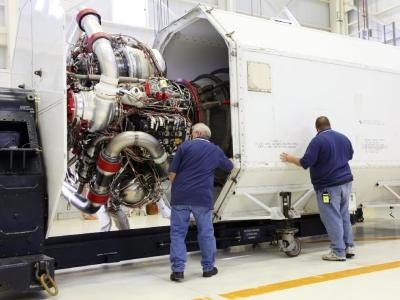
The relocation of the RS-25D space shuttle main engine inventory from Kennedy Space Center's Engine Shop in Cape Canaveral, FL, is underway. The RS-25D flight engines, repurposed for NASA's Space Launch System, are being moved to NASA's Stennis Space Center in south Mississippi.

The Space Launch System (SLS) is a new heavy-lift launch vehicle that will expand human presence beyond low-Earth orbit and enable new missions of exploration across the solar system. The Marshall Space Flight Center in Huntsville, Ala., is leading the design and development of the SLS for NASA, including the engine testing program. SLS will carry the Orion spacecraft, its crew, cargo, equipment and science experiments to destinations in deep space.

"The relocation of RS-25D engine assets represents a significant cost savings to the SLS Program by consolidating SLS engine assembly and test operations at a single facility," said William Gerstenmaier, NASA’s Associate Administrator for Human Exploration and Operations Mission Directorate.

The RS-25Ds -- to be used for the SLS core stage -- will be stored at Stennis until testing begins at a future date. Testing is already under way on the J-2X engine, which is planned for use in the SLS upper stage. Using the same fuel system -- liquid hydrogen and liquid oxygen -- for both core and upper stages reduces costs by leveraging the existing knowledge base, skills, infrastructure and personnel.

"This enables the sharing of personnel, resources and practices across all engine projects, allows flexibility and responsiveness to the SLS program, and it is more affordable," said Johnny Heflin, RS-25D core stage engine lead in the SLS Liquid Engines Office at Marshall. "It also frees up the space, allowing Kennedy to move forward relative to commercial customers."

The 15 RS-25D engines at Kennedy are being transported on the 700-mile journey using existing transportation and processing procedures that were used to move engines between Kennedy and Stennis during the Space Shuttle Program. They will be relocated one at a time by truck.
Built by Pratt & Whitney Rocketdyne of Canoga Park, Calif. the RS-25D engine powered NASA’s space shuttle program with 100 percent mission success.

FMI: www.nasa.gov/sls

Advertisement

More News

ANN's Daily Aero-Term (12.08.25): Decision Altitude (DA)

Decision Altitude (DA) A specified altitude (mean sea level (MSL)) on an instrument approach procedure (ILS, GLS, vertically guided RNAV) at which the pilot must decide whether to >[...]

ANN's Daily Aero-Linx (12.08.25)

Aero Linx: T-34 Association, Inc. The T-34 Association was formed in July 1975 so that individuals purchasing then military surplus T-34As had an organization which would provide s>[...]

NTSB Final Report: Piper PA-31T3

As He Released The Brakes To Begin Taxiing, The Brake Pedals Went To The Floor With No Braking Action Analysis: The pilot reported that during engine start up, he applied the brake>[...]

Aero-News: Quote of the Day (12.08.25)

“Legislation like the Mental Health in Aviation Act is still imperative to hold the FAA accountable for the changes they clearly acknowledge need to be made... We cannot wait>[...]

Airborne-Flight Training 12.04.25: Ldg Fee Danger, Av Mental Health, PC-7 MKX

Also: IAE Acquires Diamond Trainers, Army Drones, FedEx Pilots Warning, DA62 MPP To Dresden Tech Uni The danger to the flight training industry and our future pilots is clear. Dona>[...]

blog comments powered by Disqus



Advertisement

Advertisement

Podcasts

Advertisement

© 2007 - 2025 Web Development & Design by Pauli Systems, LC

