
D'oh! SpaceX Booster Goes for a Swim | Aero-News Network
Aero-News Network
RSS icon RSS feed
podcast icon MP3 podcast
Subscribe Aero-News e-mail Newsletter Subscribe

Airborne Unlimited -- Most Recent Daily Episodes

Episode Date

Airborne-Monday

Airborne-Tuesday

Airborne-Wednesday Airborne-Thursday

Airborne-Friday

Airborne On YouTube

Airborne-Unlimited-12.08.25

AirborneNextGen-
12.09.25

Airborne-Unlimited-12.10.25

Airborne-AffordableFlyers-12.11.25

AirborneUnlimited-12.12.25

AFE 2025 LIVE MOSAIC Town Hall (Archived): www.airborne-live.net

Fri, Dec 29, 2023

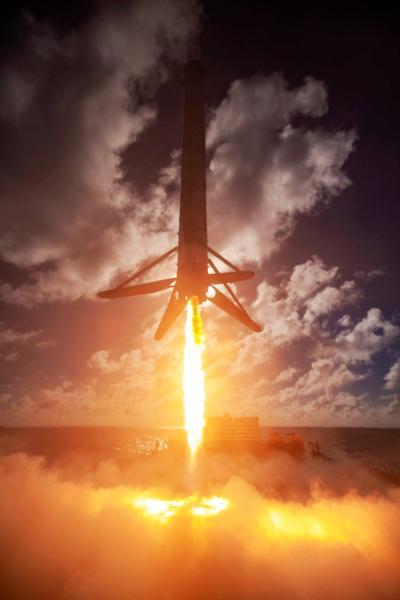
D'oh! SpaceX Booster Goes for a Swim

Improved Versions of Falcon to Sport Improved Balancing Gear

SpaceX lost one of its Falcon 9 boosters, a 19-time launch veteran, off the side of its recovery ship among rough seas on Christmas Day 2023.

The booster had soldiered on through 19 space launches, capping off its last one on December 23rd for a well-earned retirement. During the recovery process, the 135-foot tall fuselage, standing on its tail just as it does for launch, toppled over amid rising waves and increasing winds. The recovery barge returned to port missing a few feet of booster fuselage, but thankfully enough of the Falcon remained to provide some use to the company postmortem. The team will use everything left, which appears to largely be the most expensive, heaviest gear at the base. Initial images appeared to account for the full collection of Merlin 1D engines, landing gear, and the base RP-1 tank section.

“We are planning to salvage the engines and do life leader inspections on the remaining hardware,” said SpaceX’s Jon Edwards, vice president for Falcon Launch Vehicles. “There is still quite a bit of value in this booster. We will not let it go to waste.”

The booster's resume was a pretty impressive one, sporting the vintage "worm" logo of NASA's heyday in the late 70s. It flew ANASIS-11, Transporters 1 and 3, and CRS-21 in addition to scores of Starlink delivery missions. SpaceX said the booster had brought more than 860 satellites into orbit throughout its career, totaling up more than 260 metric tons over a scant 3 and a half years.

While the recovery ended in a slightly embarrassing tip-over, SpaceX has already mitigated the issue on newer variants of the Falcon series. Wider landing gear provides greater range of motion and a wider footprint, allowing them to withstand bouncier seas when the occasion calls for it.

FMI: www.spacex.com

Advertisement

More News

Aero-News: Quote of the Day (12.11.25)

"The owners envisioned something modern and distinctive, yet deeply meaningful. We collaborated closely to refine the flag design so it complemented the aircraft’s contours w>[...]

ANN's Daily Aero-Term (12.11.25): Nonradar Arrival

Nonradar Arrival An aircraft arriving at an airport without radar service or at an airport served by a radar facility and radar contact has not been established or has been termina>[...]

Classic Aero-TV: David Uhl and the Lofty Art of Aircraft Portraiture

From 2022 (YouTube Edition): Still Life with Verve David Uhl was born into a family of engineers and artists—a backdrop conducive to his gleaning a keen appreciation for the >[...]

Airborne-NextGen 12.09.25: Amazon Crash, China Rocket Accident, UAV Black Hawk

Also: Electra Goes Military, Miami Air Taxi, Hypersonics Lab, MagniX HeliStrom Amazon’s Prime Air drones are back in the spotlight after one of its newest MK30 delivery drone>[...]

Airborne 12.05.25: Thunderbird Ejects, Lost Air india 737, Dynon Update

Also: Trailblazing Aviator Betty Stewart, Wind Farm Scrutiny, Chatham Ban Overturned, Airbus Shares Dive A Thunderbird pilot, ID'ed alternately as Thunderbird 5 or Thunderbird 6, (>[...]

blog comments powered by Disqus



Advertisement

Advertisement

Podcasts

Advertisement

© 2007 - 2025 Web Development & Design by Pauli Systems, LC

