
NTSB Issues Investigative Update On Southwest Engine Failure | Aero-News Network
Aero-News Network
RSS icon RSS feed
podcast icon MP3 podcast
Subscribe Aero-News e-mail Newsletter Subscribe

Airborne Unlimited -- Most Recent Daily Episodes

Episode Date

Airborne-Monday

Airborne-Tuesday

Airborne-Wednesday Airborne-Thursday

Airborne-Friday

Airborne On YouTube

Airborne-Unlimited-12.08.25

AirborneNextGen-
12.02.25

Airborne-Unlimited-12.03.25

Airborne-FltTraining-12.04.25

AirborneUnlimited-12.05.25

AFE 2025 LIVE MOSAIC Town Hall (Archived): www.airborne-live.net

Tue, May 08, 2018

NTSB Issues Investigative Update On Southwest Engine Failure

Includes A Summary Of The Interviews Conducted By The NTSB

The NTSB ha issued an investigative update for its ongoing investigation of the fatal, April 17, engine failure on Southwest Airlines flight 1380.

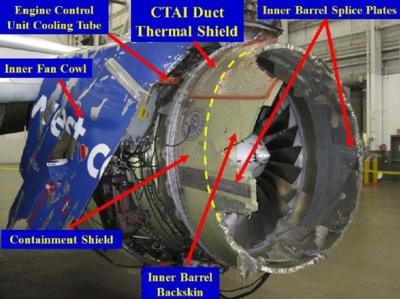
The Boeing 737, powered by CFM International engines, experienced a failure of the left CFM-56-B engine after departing New York’s LaGuardia Airport. The engine experienced a failure of a fan blade, which resulted in the loss of the engine inlet and cowling. Fragments from the cowling and engine inlet struck the fuselage, causing a rapid depressurization. The crew conducted an emergency descent and diverted to Philadelphia International Airport. There were 144 passengers and five crewmembers onboard.  One passenger suffered fatal injuries and eight passengers suffered minor injuries. The airplane was substantially damaged.

According to the investigative update, the aircraft’s maintenance records indicate, the fan blades were last overhauled 10,712 engine cycles before the accident. At the time of the last blade overhaul (November 2012), blades were fluorescent penetrant and visually inspected.

The investigative update includes a summary of the interviews conducted by the NTSB with the captain and co-captain, the three flight attendants, and a SWA employee in the cabin.

The cockpit voice recorder group has completed a draft transcript of the incident. The CVR transcript will be released when the public docket is opened.

The information in the update is preliminary and subject to change as the NTSB’s investigation progresses. Analysis of the accident facts, along with conclusions and a determination of probable cause, will come at a later date when the final report on the investigation is completed. As such, no conclusions about how the incident happened should be drawn from the information contained within the preliminary report.

The incident marks the first fatality involving a U.S. registered commercial passenger air carrier since the 2009 Colgan Air flight 3407 crash near Buffalo, New York.

(Image provided with NTSB news release)

FMI: www.ntsb.gov

Advertisement

More News

NTSB Final Report: Patriot Aircraft LLC CX1900A

After Draining Both Wing Fuel Tanks, A Significant Amount Of Water Was Observed In The Right Wing Fuel Tank Analysis: The pilot, who was also the owner of the experimental amateur->[...]

Aero-News: Quote of the Day (12.06.25)

“Airbus apologises for any challenges and delays caused to passengers and airlines by this event. The Company thanks its customers, the authorities, its employees and all rel>[...]

ANN's Daily Aero-Term (12.06.25): High Speed Taxiway

High Speed Taxiway A long radius taxiway designed and provided with lighting or marking to define the path of aircraft, traveling at high speed (up to 60 knots), from the runway ce>[...]

ANN's Daily Aero-Linx (12.06.25)

Aero Linx: Taylorcraft Foundation, Inc. The Taylorcraft Foundation is exclusively organized for charitable, educational & scientific activities and will preserve the history an>[...]

Airborne-NextGen 12.02.25: Honda eVTOL, Arctus High-Alt UAS, Samson Patent

Also: USAF Reaper Accident, Baikonur Damage, Horizon eVTOL IFR/FIKI, New Glenn Update Honda has outlined its clearest timeline yet for its entry into the world of electric vertical>[...]

blog comments powered by Disqus



Advertisement

Advertisement

Podcasts

Advertisement

© 2007 - 2025 Web Development & Design by Pauli Systems, LC

