

NASA Crew Completes First Simulated Mars Mission | Aero-News Network
Aero-News Network
RSS icon RSS feed
podcast icon MP3 podcast
Subscribe Aero-News e-mail Newsletter Subscribe

Airborne Unlimited -- Most Recent Daily Episodes

Episode Date

Airborne-Monday

Airborne-Tuesday

Airborne-Wednesday Airborne-Thursday

Airborne-Friday

Airborne On YouTube

Airborne-Unlimited-12.01.25

AirborneNextGen-
12.02.25

Airborne-Unlimited-12.03.25

Airborne-FltTraining-12.04.25

AirborneUnlimited-12.05.25

AFE 2025 LIVE MOSAIC Town Hall (Archived): www.airborne-live.net

Sat, Jul 06, 2024

NASA Crew Completes First Simulated Mars Mission

Volunteers Ending Yearlong Mission in Mars Dune Alpha Habitat

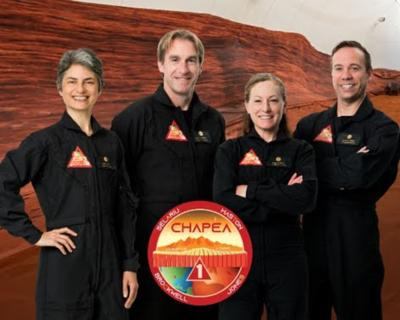
NASA is gathering important baseline data and information that will help guide planning for the first human-crewed mission to Mars through its “analog” Crew Health and Performance Exploration Analog (CHAPEA) ground-based missions. 

The first of three such missions in the Mars Dune Alpha habitat will come to an end July 6, 2024, when the volunteer crew emerges from the habitat after a year-long test of living and working in an isolated environment.

The habitat is a 3D printed structure built to resemble an actual habitat that would be constructed and used on Mars.

It has 1,700 square feet of separate spaces for living and working, a medical bay, and a galley and food growing areas.

The four crew members were recruited from the public to live for a year in conditions that resemble what an actual mission crew might experience on Mars. 

They were put through simulated Mars mission operations such as maintaining their habitat and its equipment, Marswalks, and growing vegetables to supplement the shelf-stable food provisions.

They were also subjected to anticipated stressors including the 4-25 minute delay each way when communicating with Earth, isolation, menu fatigue, and limited resources. The data will provide NASA information and valuable insights to assess the crew’s physical and behavioral health, performance, and to evaluate the food systems.

The crew will exit the habitat at 5 pm EDT at NASA’s Johnson Space Center in Houston, Texas.

FMI:  www.nasa.gov/humans-in-space/chapea/, www.nasa.gov/analog-missions/

Advertisement

More News

ANN's Daily Aero-Term (12.04.25): Cooperative Surveillance

Cooperative Surveillance Any surveillance system, such as secondary surveillance radar (SSR), wide-area multilateration (WAM), or ADS-B, that is dependent upon the presence of cert>[...]

ANN's Daily Aero-Linx (12.04.25)

Aero Linx: OX5 Aviation Pioneers Incorporated in 1955 as a Pa 501 (c)(3) Not for Profit Corporation, the OX5 Aviation Pioneers is dedicated to bringing before the public the accomp>[...]

NTSB Prelim: Extra Flugzeugproduktions EA 300/SC

The Pilot Appeared To Regain Control After Six Rotations And Attempted To “Fly Out” Inverted But Had Insufficient Altitude On November 8, 2025, at 1038 eastern standard>[...]

Classic Aero-TV: The Bally Bomber - The All Time Ultimate Warbird Replica?

From 2018 (YouTube Edition): Aero-News Talks With The Airplane's Builder One of the many unique airplanes at AirVenture 2018 was a 1/3-scale B-17 bomber built by Jack Bally, who ta>[...]

ANN's Daily Aero-Linx (12.05.25)

Aero Linx: Society of U.S. Army Flight Surgeons (SoUSAFS) The Society of US Army Flight Surgeons (SoUSAFS) serves to advance the science and art of Aerospace Medicine and its allie>[...]

blog comments powered by Disqus



Advertisement

Advertisement

Podcasts

Advertisement

© 2007 - 2025 Web Development & Design by Pauli Systems, LC

