One Heckuva Ride...
As part of their suborbital spaceflight training program,
Southwest Research Institute researchers and suborbital payload
specialists Dr. Alan Stern and Dr. Dan Durda have continued their
spaceflight training with a new series of jet fighter flights in
F-104 aircraft operated by Starfighters Inc. at the Kennedy Space
Center, Fla. This new round of SwRI Starfighter flights and ground
training took place Nov. 16.
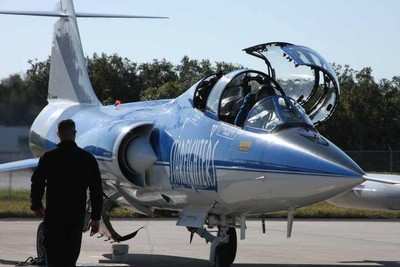
This followed on an intensive, two-day course, which Stern and
Durda took to inaugurate this element of their spaceflight
training, and which included classroom instruction, aircraft
cockpit familiarization and actual flights flown from the Shuttle
Landing Facility at the Kennedy Space Center earlier in 2010.
“The flight profiles we flew in November were designed to
give us repeated acclimatization to 5-6 Gs during ascent profiles
like those we’ll experience in suborbital launches, and each
zoomed ascent in the F-104 was topped with a zero-G parabola to
simulate the transition from hyper-Gs to micro-gravity,” says
Principal Investigator Stern, associate vice president in the SwRI
Space Science and Engineering Division. “We each flew six of
these ascent/zero-G launch profiles and wore a NASA-like biomedical
harness like the ones we plan to wear in spaceflight. The harness
monitored our blood pressure, and we evaluated the comfort and
distraction potential of the harness and in both the micro-G and
hyper-G portions of the flight to pathfind wearability for other
suborbital researchers.”
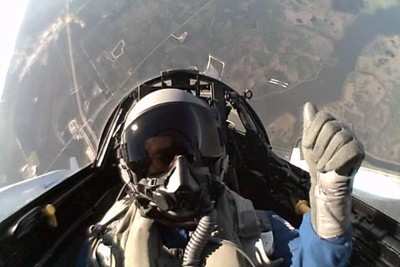
Dr. Alan Stern
“In addition I carried an engineering model of a
microgravity experiment we plan to fly in space and evaluated that
hardware’s design and functionality in zero-G,” says
co-investigator Durda, a principal scientist at the SwRI Planetary
Science Directorate. “Our pilots, Rick Svetkoff and Mike
Smith, did a great job for us again, giving us everything we wanted
out of these flights, which we scored as an A+ on both the training
and the equipment evaluations.”
Starfighters is the only commercial aviation organization that
holds written permission from both NASA and the Federal Aviation
Administration to conduct this type of training.
Stern, who holds a commercial pilot license and is a certified
flight instructor, has served as principal investigator on seven
unmanned NASA suborbital rocket missions, has flown on numerous
high-altitude research missions in NASA WB-57 and F/A-18 aircraft,
and has participated in research expeditions in both the Arctic and
Antarctic. He was previously NASA’s associate administrator
for science, and he is currently the chair of the Commercial
Spaceflight Federation’s suborbital research applications
committee.
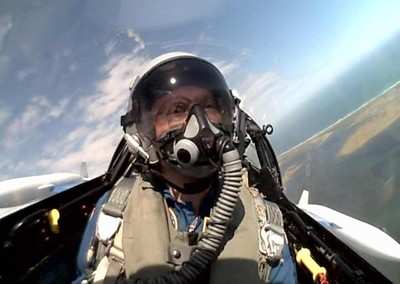
Dr. Dan Durda
Durda, a planetary scientist, is an experienced SCUBA cave
rescue diver, a participant in F/A-18 and KC-135 research missions
and an instrument-rated pilot.
Stern and Durda are working on this project under an SwRI-funded
effort aimed at conducting in-space experiments using
next-generation suborbital vehicles for various kinds of scientific
research and public outreach. An earlier portion of this project
included altitude chamber and centrifuge training at The NASTAR
Center near Philadelphia.



 Classic Aero-TV: In Praise of Alabamas Patriot Aircraft USA


 See All