
Expedition 16 Spacewalkers Wrap Up Tricky Excursion | Aero-News Network
Aero-News Network
RSS icon RSS feed
podcast icon MP3 podcast
Subscribe Aero-News e-mail Newsletter Subscribe

Airborne Unlimited -- Most Recent Daily Episodes

Episode Date

Airborne-Monday

Airborne-Tuesday

Airborne-Wednesday Airborne-Thursday

Airborne-Friday

Airborne On YouTube

Airborne-SpecialEpisode-12.15.25

AirborneNextGen-
12.16.25

Airborne-Unlimited-12.10.25

Airborne-AffordableFlyers-12.11.25

AirborneUnlimited-12.12.25

AFE 2025 LIVE MOSAIC Town Hall (Archived): www.airborne-live.net

Wed, Jan 30, 2008

Expedition 16 Spacewalkers Wrap Up Tricky Excursion

Whitson, Tani Repair Problem To Power Generation System

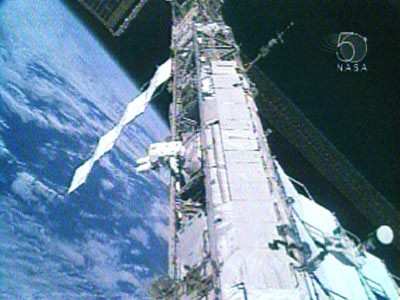
Let there be light... onboard the International Space Station, that is. Early Wednesday afternoon, Expedition 16 Commander Peggy Whitson and Flight Engineer Dan Tani finished a seven hour, 10 minute spacewalk outside the ISS, to make repairs on the starboard side of the truss structure.

NASA reports the spacewalkers successfully removed and replaced a Bearing Motor Roll Ring Module (BMRRM) that experienced electrical failure December 8. The BMRRM, or "broom," drives the solar arrays as they tilt towards the sun, maximizing power generation.

While the panels continued to produce energy, the faulty motor prevented the panels on the station's right side from tracking the sun, curbing the station's power-generation capabilities.

Mission Control reported good electrical continuity to the new BMRRM. While spacewalkers were still outside, flight controllers completed a planned three-degree rotation and then did a 360-degree rotation of those solar wings. NASA engineers pronounced the repairs a success, stating the station's right-side solar power module is now generating enough power to support the planned deliveries of the Japanese "Kibo" science module to the station in March and April.

"Yee haw," said Whitson, when Mission Control told her the repair was successful. "Thanks a lot."

"Great. Fantastic," echoed Tani, reports The Houston Chronicle.

The excursion was somewhat riskier than other spacewalks, as the astronauts had to work in close proximity to the high-voltage solar panels. The spacewalkers could only work while the station was in darkness... as when sunlight hits the panels, dangerously high levels of electricity spike through the cables they had to handle.

The motor is part of the Beta Gimbal Assembly, which experienced electrical failures December 8. Including pauses for the daylight parts of orbit, the removal and replacement of the BMRRM took about three hours.

The second major task of the spacewalk was inspection of the starboard Solar Alpha Rotary Joint (SARJ), which causes the starboard solar wings to rotate in a paddlewheel-like motion to keep the arrays pointed toward the sun. Previous inspections revealed contamination and debris inside that joint. Eight SARJ covers were removed for Wednesday's inspection.

Station Flight Engineer Yuri Malenchenko helped the crew with suiting up and provided other support. Astronaut Tom Marshburn was the ground intravehicular officer. He was in the station flight control room in Houston's Mission Control Center, acting as spacewalk choreographer.

Once tasks their tasks were completed and after cleanup the spacewalkers re-entered the Quest airlock and closed its hatch. The beginning of repressurization at 1206 EST marked the official end of the spacewalk.

(Photo courtesy of NASA TV)

FMI: www.spaceflight.nasa.gov

Advertisement

More News

Aero-News: Quote of the Day (12.18.25)

“These new aircraft strengthen our ability to respond quickly, train effectively and support communities nationwide. Textron Aviation has been a steadfast supporter in helpin>[...]

Classic Aero-TV: Viking Twin Otter 400--Bringing the DHC-6 Back Into Production

From 2011 (YouTube Edition): Rugged, Legendary, STOL Twin Makes A Comeback The de Havilland Twin Otter is an airplane with a long history, and it gained a reputation as a workhorse>[...]

NTSB Final Report: Rans Employee Flying Club Rans S-6ES Coyote II

A Wind Gust Lifted The Right Wing And The Airplane Turned To The Left Analysis: The pilot was departing from a 2,395-ft-long by 50-ft-wide turf runway. The pilot reported that afte>[...]

ANN FAQ: Submit a News Story!

Have A Story That NEEDS To Be Featured On Aero-News? Here’s How To Submit A Story To Our Team Some of the greatest new stories ANN has ever covered have been submitted by our>[...]

ANN's Daily Aero-Term (12.18.25): Braking Action Advisories

Braking Action Advisories When tower controllers receive runway braking action reports which include the terms “medium," “poor," or “nil," or whenever weather con>[...]

blog comments powered by Disqus



Advertisement

Advertisement

Podcasts

Advertisement

© 2007 - 2025 Web Development & Design by Pauli Systems, LC

