Tue, Nov 15, 2016
Portable, Autonomous Flight System To Be Demonstrated On Huey
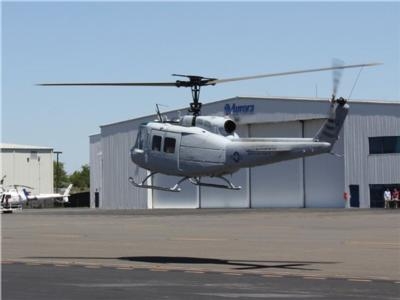
Aurora Flight Sciences continues to break ground on the development of advanced autonomous capabilities for vertical take-off and landing (VTOL) systems. Aurora's work on the Autonomous Aerial Cargo Utility System (AACUS) program will be leveraged to integrate the company's Tactical Autonomous Aerial Logistics System (TALOS) on a UH-1H helicopter. The primary goal of the AACUS program is to enable rapid cargo delivery by unmanned, and potentially optionally-manned, VTOL systems. AACUS encompasses the development and implementation of VTOL-based obstacle detection and avoidance, and allows for autonomous landings at unprepared, off-field, non-cooperative landing sites. AACUS also enables dynamic contingency planning to the point of landing, with goal-based supervisory control by any field personnel with no special training.
At the AACUS flight testing event held today in Northern Virginia, the AACUS program demonstrated on a manned Bell 206 the perception and planning capabilities required for autonomous takeoff, transit and landing. "We know how to make things fly, we've been doing it for over 100 years," said Retired Brig. Gen. Frank Kelley, the Deputy Assistant Secretary of the Navy for Unmanned Systems. "What we don't yet know how to do, is how to couple aircraft and autonomous systems together, but great programs like this are helping us get there."
Aurora's TALOS system has been demonstrated previously on a Boeing H-6U Unmanned Little Bird flown autonomously, and three different human-piloted Bell 206 aircraft. "The arrival of a Huey as our third test platform frames a key point for future customers – the TALOS system is platform agnostic; you're not buying a new fleet of helicopters, you're buying a capability set for your current fleet," said John Wissler, Vice President of Aurora's R&D Center in Cambridge, Massachusetts. "TALOS is not an aircraft, nor is it a robot flying an aircraft –TALOS is transferable intelligence designed with both manned and unmanned aircraft requirements in mind. The value of TALOS can be described in a few words – platform agnostic, scalable autonomy, onboard sensing of the environment, and on-board intelligence that no other system in the world can provide."
Commercial applications for the TALOS technology are also being explored by Aurora. "Think of the civilian first responder pilot attempting to land in a remote, storm-ravaged area at night – TALOS senses and alerts to power lines and landing zone obstacles well before the pilot and informs the pilot's maneuvers," said Wissler.
(Image provided with Aurora Flight Sciences news release)
More News
Its Offerings Are Lighter, Cleaner, and Now Pushing Past 1,000nm on SAF Jet Fuel DeltaHawk’s diesel-powered aircraft lineup has seen incredible upgrades over the last few yea>[...]
The Airplane Experienced A Total Loss Of Engine Power On December 3, 2025, about 1600 central standard time, a Mooney Aircraft Corp. M20K, N57229, was substantially damaged when it>[...]
Make Sure You NEVER Miss A New Story From Aero-News Network Do you ever feel like you never see posts from a certain person or page on Facebook or Instagram? Here’s how you c>[...]
Aero Linx: European Society of Aerospace Medicine (ESAM) As a pan-European, independent forum, it works to promote the safety and health of all persons involved in aviation and spa>[...]
“We are excited to see Wisk achieve this milestone, and I’m so proud of the team that made it possible. The team at Wisk has built advanced technologies across flight c>[...]



 Aero-TV: DeltaHawks Diesel Power Steps Into the Spotlight


 See All