Mon, Apr 22, 2013
Data Presented At Symposium In Nashville, TN
Three unusually long-lasting stellar explosions discovered by NASA’s Swift satellite represent a previously unrecognized class of gamma-ray bursts (GRBs). Two international teams of astronomers studying these events conclude that they likely arose from the catastrophic death of supergiant stars hundreds of times larger than the sun. The astronomers discussed their findings Tuesday at the 2013 Huntsville Gamma-ray Burst Symposium in Nashville, TN, a meeting sponsored in part by the University of Alabama at Huntsville and NASA's Swift and Fermi Gamma-ray Space Telescope missions.
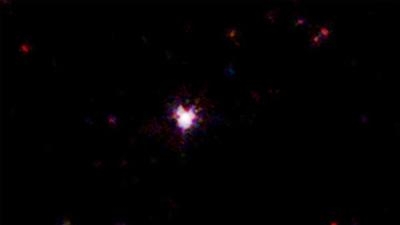
GRBs are the most luminous and mysterious explosions in the universe. The blasts emit surges of gamma rays -- the most powerful form of light -- as well as X-rays, and they produce afterglows that can be observed at optical and radio energies. Swift, Fermi and other spacecraft detect an average of about one GRB each day. "We have seen thousands of gamma-ray bursts over the past four decades, but only now are we seeing a clear picture of just how extreme these extraordinary events can be," said Bruce Gendre, a researcher now associated with the French National Center for Scientific Research who led this study while at the Italian Space Agency's Science Data Center in Frascati, Italy.
Prior to Swift's launch in 2004, satellite instruments were much less sensitive to gamma-ray bursts that unfolded over comparatively long time scales. Traditionally, astronomers have recognized two GRB types, short and long, based on the duration of the gamma-ray signal. Short bursts last two seconds or less and are thought to represent a merger of compact objects in a binary system, with the most likely suspects being neutron stars and black holes. Long GRBs may last anywhere from several seconds to several minutes, with typical durations falling between 20 and 50 seconds. These events are thought to be associated with the collapse of a star many times the sun's mass and the resulting birth of a new black hole. Both scenarios give rise to powerful jets that propel matter at nearly the speed of light in opposite directions. As they interact with matter in and around the star, the jets produce a spike of high-energy light.

Gendre and his colleagues made a detailed study of GRB 111209A, which erupted on Dec. 9, 2011, using gamma-ray data from the Konus instrument on NASA's Wind spacecraft, X-ray observations from Swift and the European Space Agency's XMM-Newton satellite, and optical data from the TAROT robotic observatory in La Silla, Chile. The burst continued to produce high-energy emission for an astonishing seven hours, making it by far the longest-duration GRB ever recorded. The team's findings appear in the March 20 edition of The Astrophysical Journal.
Another event, GRB 101225A, exploded on Christmas Day in 2010 and produced high-energy emission for at least two hours. Subsequently nicknamed the "Christmas burst," the event's distance was unknown, which led two teams to arrive at radically different physical interpretations. One group concluded the blast was caused by an asteroid or comet falling onto a neutron star within our own galaxy. Another team determined that the burst was the outcome of a merger event in an exotic binary system located some 3.5 billion light-years away.
(Image provided by NASA)
More News
Its Offerings Are Lighter, Cleaner, and Now Pushing Past 1,000nm on SAF Jet Fuel DeltaHawk’s diesel-powered aircraft lineup has seen incredible upgrades over the last few yea>[...]
The Airplane Experienced A Total Loss Of Engine Power On December 3, 2025, about 1600 central standard time, a Mooney Aircraft Corp. M20K, N57229, was substantially damaged when it>[...]
Make Sure You NEVER Miss A New Story From Aero-News Network Do you ever feel like you never see posts from a certain person or page on Facebook or Instagram? Here’s how you c>[...]
Aero Linx: European Society of Aerospace Medicine (ESAM) As a pan-European, independent forum, it works to promote the safety and health of all persons involved in aviation and spa>[...]
“We are excited to see Wisk achieve this milestone, and I’m so proud of the team that made it possible. The team at Wisk has built advanced technologies across flight c>[...]



 Aero-TV: DeltaHawks Diesel Power Steps Into the Spotlight


 See All