Study Published On Eve Of Dreamliner Rollout
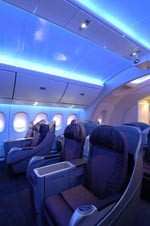 Timing, as the say, is
everything. Boeing funded and conducted a study of the
relationshiop between cabin pressurization in airliners, to
passenger discomfort. The results of that study appear in the July
5 issue of the New England Journal of Medicine... three days before
the public rollout of Boeing's own 787 Dreamliner, which --
coincidentally -- will feature a cabin pressurized to a lower
altitude.
Timing, as the say, is
everything. Boeing funded and conducted a study of the
relationshiop between cabin pressurization in airliners, to
passenger discomfort. The results of that study appear in the July
5 issue of the New England Journal of Medicine... three days before
the public rollout of Boeing's own 787 Dreamliner, which --
coincidentally -- will feature a cabin pressurized to a lower
altitude.
Most aircraft cabins are pressurized to 8,000 feet, which lowers
blood oxygen saturation by about four percentage points. The study
says pressurizing a cabin to 6,000 feet would help some passengers
feel better while flying, according to Health Day News.
"We found that the altitudes did not affect the occurrence of
acute mountain sickness syndrome, but it did affect discomfort,"
said Dr. J. Michael Muhm, the study's lead author. He is also the
senior occupation physician for Boeing Commercial Airplanes in
Seattle, which funded the study.
Acute Mountain sickness (AMS) is a high altitude illness that
causes such symptoms as headache, insomnia, nausea, anorexia and
dizziness. A high altitude headache, (HAH) is the most prominent
symptom of AMS, according to the Brady Critical Care Paramedic
textbook.
"There was no difference in the likelihood of discomfort at
ground level and 6,000 feet, but the likelihood increased between
6,000 and 8,000 feet," Muhm said. "We concluded that passenger and
crew comfort would be enhanced if the cabin was pressurized to
6,000 feet during long-duration flights."
One of the things the study's authors wanted to find out is if
air travelers were prone to AMS, or other high altitude
maladies.
"The average Joe in good condition could tolerate 8,000 feet
without health effects," said Dr. Claude Thibeault, medical
director of the International Air Transport Association in
Montreal. But, "They didn't say without discomfort."
The study had 502 adult volunteers take part in a 20-hour
simulated flight. It measured the effects of barometric pressures
on arterial oxygen saturation of altitudes at 650, 4,000, 6,000,
7,000 and 8,000 feet equivalencies and the accompanying rates of
AMS and discomfort.
As altitude increased, mean oxygen saturation decreased. At
8,000 feet it reached the maximum decrease of 4.4 percentage
points, according to the study.
AMS, the mildest and most common form of high altitude
illnesses, was recorded in 7.4 percent of participants, but the
incidences did not vary between different altitudes. Generally, the
greater the altitude, the greater the discomfort -- with the worst
at 7,000 to 8,000 feet, and discomfort beginning around 3 to 9
hours into the simulated flight. People over 60 were less likely to
report discomfort and men appeared to be more affected overall than
women.
"There were no health effects, but the discomfort was there,"
Thibeault said. "What they were trying to do in this study is
isolate one factor, which is altitude, so you can't blame these
effects on other factors."
Boeing is scheduled to publically unveil its 787 -- which will
sport a cabin pressurized to 6,000 feet -- on Sunday.
"The 787 is one of our first airplanes with the fuselage made
out of composites rather than aluminum, a structure that allows us
to pressurize to 6,000 feet," said Jeanne Yu, director of
environmental performance for Boeing. "The findings of this study,
as well as the development of materials technology, enable us to
fly the 787."



 ANN's Daily Aero-Term (12.04.25): Cooperative Surveillance


 See All