
NASA Talk Examines How Little Wings Make A Big Difference | Aero-News Network
Aero-News Network
RSS icon RSS feed
podcast icon MP3 podcast
Subscribe Aero-News e-mail Newsletter Subscribe

Airborne Unlimited -- Most Recent Daily Episodes

Episode Date

Airborne-Monday

Airborne-Tuesday

Airborne-Wednesday Airborne-Thursday

Airborne-Friday

Airborne On YouTube

Airborne-Unlimited-11.24.25

AirborneNextGen-
11.18.25

Airborne-Unlimited-11.19.25

Airborne-AffordableFlyers-11.20.25

AirborneUnlimited-11.21.25

LIVE MOSAIC Town Hall (Archived): www.airborne-live.net

Tue, Dec 01, 2015

NASA Talk Examines How Little Wings Make A Big Difference

Lecture Will Focus On How Winglets Make Airplanes More Efficient

They sound like a featured item on a restaurant menu, but winglets – those vertical, upturned tips at the end of an airplane's wing – are one of aviation's most important and visible cost-saving technologies.

If you happen to live in the Hampton, VA area, Robert Gregg, the chief aerodynamicist for Boeing Commercial Airplanes will present "The Evolution of Winglets to the Max" at 2 p.m. in the Pearl Young Theater on Tuesday, Dec. 1, at NASA's Langley Research Center.

During the 1973 oil crisis, NASA Langley aeronautical engineer Richard Whitcomb designed and tested a vertical wingtip that he called a winglet – a device that reduces wingtip vortices and creates less drag. With less drag, an aircraft uses less fuel with fewer emissions, can carry more payload, and has a greater range. Winglets also help planes operate more quietly by reducing noise.

Aviation Partners Boeing (APB), a partnership with Seattle-based Aviation Partners Inc. and The Boeing Company has estimated that winglets have saved billions of gallons of jet fuel worldwide, saving billions of dollars and reducing carbon dioxide emissions by over 20 million tons.

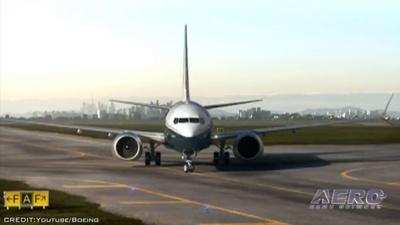
Gregg's talk will explore the history of Whitcomb's concept, and a new advanced technology winglet and other features on Boeing's 737 Max scheduled for its maiden flight in early 2016.

The lead for Boeing's Flight Sciences efforts on the configuration development for the 737 MAX, 787-10X, 767-2C, and 777X, along with managing the Flight Sciences Technology portfolio, Gregg has over 37 years of experience in aircraft development, advanced aircraft and aerodynamic concepts, and technology research. He has patents on wing and airfoil design concepts for efficient transonic transports, powered high-lift concepts, and short takeoff and landing configurations. Gregg received a Bachelor of Science in aeronautics and astronautics from the University of Illinois and a Master of Science in aerospace engineering from the University of Southern California.

(Source: NASA news release. Image from file)

FMI: http://colloqsigma.larc.nasa.gov

Advertisement

More News

ANN's Daily Aero-Term (11.28.25): Unmanned Aircraft System (UAS)

Unmanned Aircraft System (UAS) An unmanned aircraft and its associated elements related to safe operations, which may include control stations (ground, ship, or air based), control>[...]

ANN's Daily Aero-Linx (11.28.25)

Aero Linx: Cactus Fly-In The Classic Airplane Association of Arizona, Inc. (CAAA) was incorporated in Arizona as a not for profit corporation on January 10, 2014. The CAAA roster i>[...]

Airborne 11.21.25: NTSB on UPS Accident, Shutdown Protections, Enstrom Update

Also: UFC Buys Tecnams, Emirates B777-9 Buy, Allegiant Pickets, F-22 And MQ-20 The NTSB's preliminary report on the UPS Flight 2976 crash has focused on the left engine pylon's sep>[...]

Airborne 11.26.25: Bonanza-Baron Fini, Archer v LA NIMBYs, Gogo Loses$$$

Also: Bell 505 on SAF, NYPA Gets Flak For BizAv 'Abuse', FAA Venezuela Caution, Horizon Update Textron Aviation has confirmed it will be ending production of the Beechcraft Bonanza>[...]

Airborne-NextGen 11.25.25: EHang Manned Flt, Army UAVs, Starship V3 Booster Boom

Also: FedEx SAF, Archer Midnight Powertrain Tech, Rocket Lab Record, Perseverance Rover Find EHang has logged a major milestone in the development of its pilotless air taxi, loggin>[...]

blog comments powered by Disqus



Advertisement

Advertisement

Podcasts

Advertisement

© 2007 - 2025 Web Development & Design by Pauli Systems, LC

