
NASA's JWST Completes Acoustic And Vibration Tests | Aero-News Network
Aero-News Network
RSS icon RSS feed
podcast icon MP3 podcast
Subscribe Aero-News e-mail Newsletter Subscribe

Airborne Unlimited -- Most Recent Daily Episodes

Episode Date

Airborne-Monday

Airborne-Tuesday

Airborne-Wednesday Airborne-Thursday

Airborne-Friday

Airborne On YouTube

Airborne-Unlimited-12.08.25

AirborneNextGen-
12.09.25

Airborne-Unlimited-12.10.25

Airborne-AffordableFlyers-12.11.25

AirborneUnlimited-12.12.25

AFE 2025 LIVE MOSAIC Town Hall (Archived): www.airborne-live.net

Tue, Apr 11, 2017

NASA's JWST Completes Acoustic And Vibration Tests

Two Of Many Tests Designed To Prepare Spacecraft For Launch

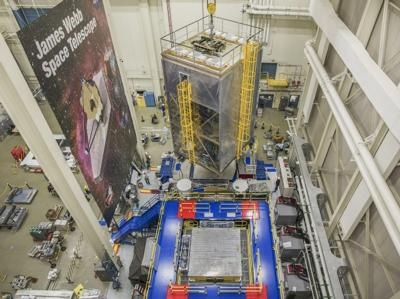
At NASA's Goddard Space Flight Center in Greenbelt, Maryland the James Webb Space Telescope team completed the acoustic and vibration portions of environmental testing on the telescope. These tests are merely two of the many that spacecraft and instruments endure to ensure they are fit for spaceflight.

For the acoustic test, the telescope was wrapped in a clean tent, and engineers and technicians pushed it through a large pair of insulated steel doors nearly a foot thick into the Acoustic Test Chamber. In the chamber the telescope was exposed to the earsplitting noise and resulting vibration of launch.

A new vibration test system also known as a shaker table, was built specifically for testing the Webb. The Webb was mounted on the shaker table and experienced the simulated forces the

telescope will feel during the launch by vibrating it from 5 to 100 times per second. The test ensures a spacecraft like Webb can withstand the vibrations that occur as a result of the ride into space on a rocket.

This spring, after other environmental tests are completed, the Webb telescope will be shipped to NASA's Johnson Space Center in Houston, Texas, for end-to-end optical testing in a vacuum at its extremely cold operating temperatures, before it goes to Northrop Grumman Aerospace Systems in Redondo Beach, California, for final assembly and testing prior to launch.

By performing these tests, scientists and engineers can ensure that the spacecraft and all of its instruments will endure the launch and maintain functionality when it is launched from French Guiana in 2018.

The James Webb Space Telescope is the scientific successor to NASA's Hubble Space Telescope. It will be the most powerful space telescope ever built. Webb is an international project led by NASA with its partners, ESA (European Space Agency) and the Canadian Space Agency.

(Image provided with NASA news release)

FMI: www.nasa.gov, Test Video

Advertisement

More News

ANN FAQ: Contributing To Aero-TV

How To Get A Story On Aero-TV News/Feature Programming How do I submit a story idea or lead to Aero-TV? If you would like to submit a story idea or lead, please contact Jim Campbel>[...]

Aero-News: Quote of the Day (12.10.25)

“As the excitement builds for the world of flight returning to Oshkosh in 2026, we wanted to ensure that advance tickets are available for those who enjoy giving AirVenture t>[...]

ANN's Daily Aero-Term (12.10.25): North Atlantic High Level Airspace (NAT HLA)

North Atlantic High Level Airspace (NAT HLA) That volume of airspace (as defined in ICAO Document 7030) between FL 285 and FL 420 within the Oceanic Control Areas of Bodo Oceanic, >[...]

Airborne 12.08.25: Samaritan’s Purse Hijack, FAA Med Relief, China Rocket Fail

Also: Cosmonaut Kicked Out, Airbus Scales Back, AF Silver Star, Russian A-60 Clobbered A Samaritan’s Purse humanitarian flight was hijacked on Tuesday, December 2, while atte>[...]

Airborne-Flight Training 12.04.25: Ldg Fee Danger, Av Mental Health, PC-7 MKX

Also: IAE Acquires Diamond Trainers, Army Drones, FedEx Pilots Warning, DA62 MPP To Dresden Tech Uni The danger to the flight training industry and our future pilots is clear. Dona>[...]

blog comments powered by Disqus



Advertisement

Advertisement

Podcasts

Advertisement

© 2007 - 2025 Web Development & Design by Pauli Systems, LC

