Sat, Feb 11, 2012
Data Registers Modified To Correct Reset Problem
Engineers have found the root cause of a computer reset that
occurred two months ago on NASA's Mars Science Laboratory and have
determined how to correct it. The fix involves changing how certain
unused data-holding locations, called registers, are configured in
the memory management of the type of computer chip used on the
spacecraft. Billions of runs on a test computer with the modified
register configuration yielded no repeat of the reset behavior. The
mission team made this software change on the spacecraft's computer
last week and confirmed this week that the update is
successful.
Curiosity Rover Artist's Concept
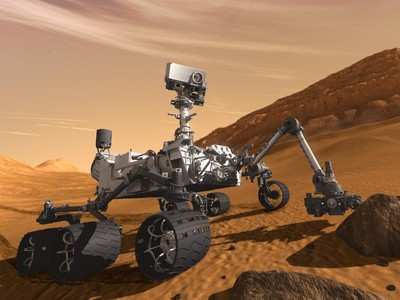
The reset occurred Nov. 29, 2011, three days after launch,
during use of the craft's star scanner. The cause has been
identified as a previously unknown design idiosyncrasy in the
memory management unit of the Mars Science Laboratory computer
processor. In rare sets of circumstances unique to how this mission
uses the processor, cache access errors could occur, resulting in
instructions not being executed properly. This is what happened on
the spacecraft on Nov. 29.
"Good detective work on understanding why the reset occurred has
yielded a way to prevent it from occurring again," said Mars
Science Laboratory Deputy Project Manager Richard Cook of NASA's
Jet Propulsion Laboratory, Pasadena, CA. "The successful resolution
of this problem was the outcome of productive teamwork by engineers
at the computer manufacturer and JPL."
The Mars-bound spacecraft performed a brief alignment activity
using its star scanner and sun sensor on January 26. During the
alignment observations, the star scanner detected Mars. "Our target
is in view," said JPL's Steve Collins, attitude control subsystem
engineer for Mars Science Laboratory's cruise from Earth to
Mars.
Curiosity Launch
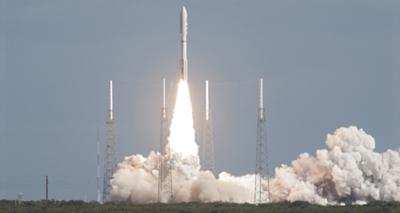
The spacecraft began normal use of its star tracker and true
celestial navigation this week after its software update. The Mars
Science Laboratory mission will use its car-size rover, Curiosity,
to investigate whether the selected region on Mars inside Gale
Crater has offered environmental conditions favorable for
supporting microbial life and favorable for preserving clues about
whether life existed. Curiosity is scheduled to land on Mars on
Aug. 6, 2012, Universal Time and Eastern Daylight Time.
The spacecraft's cruise-stage solar array is producing 704 watts.
The telecommunications rates are 1 kilobit per second for uplink
and 800 bits per second for downlink. The spacecraft is spinning at
1.97 rotations per minute.
As of 1200 EST, (1700 Universal Time) on Friday, February 10, the
spacecraft had traveled 127 million miles of its 352-million-mile
flight to Mars. It will be moving at about 17,800 miles per hour
relative to Earth and at about 63,700 mph relative to the sun.
(Images provided by NASA)
More News
How To Get A Story On Aero-TV News/Feature Programming How do I submit a story idea or lead to Aero-TV? If you would like to submit a story idea or lead, please contact Jim Campbel>[...]
“As the excitement builds for the world of flight returning to Oshkosh in 2026, we wanted to ensure that advance tickets are available for those who enjoy giving AirVenture t>[...]
North Atlantic High Level Airspace (NAT HLA) That volume of airspace (as defined in ICAO Document 7030) between FL 285 and FL 420 within the Oceanic Control Areas of Bodo Oceanic, >[...]
Also: Cosmonaut Kicked Out, Airbus Scales Back, AF Silver Star, Russian A-60 Clobbered A Samaritan’s Purse humanitarian flight was hijacked on Tuesday, December 2, while atte>[...]
Also: IAE Acquires Diamond Trainers, Army Drones, FedEx Pilots Warning, DA62 MPP To Dresden Tech Uni The danger to the flight training industry and our future pilots is clear. Dona>[...]



 ANN FAQ: Contributing To Aero-TV


 See All