
Air Force: Drone Accident Rate At Civilian Airports 'Unacceptably High' | Aero-News Network
Aero-News Network
RSS icon RSS feed
podcast icon MP3 podcast
Subscribe Aero-News e-mail Newsletter Subscribe

Airborne Unlimited -- Most Recent Daily Episodes

Episode Date

Airborne-Monday

Airborne-Tuesday

Airborne-Wednesday Airborne-Thursday

Airborne-Friday

Airborne On YouTube

Airborne-Unlimited-11.24.25

AirborneNextGen-
11.18.25

Airborne-Unlimited-11.19.25

Airborne-AffordableFlyers-11.20.25

AirborneUnlimited-11.21.25

LIVE MOSAIC Town Hall (Archived): www.airborne-live.net

Wed, Dec 12, 2012

Air Force: Drone Accident Rate At Civilian Airports 'Unacceptably High'

Pilot Error, Software Issues, Mechanical Failures All Cited As Causes

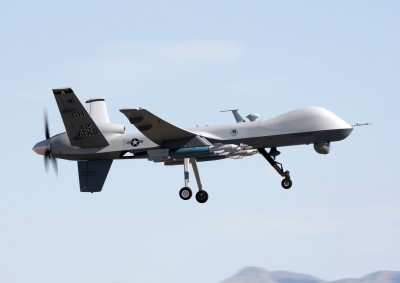
Internal Air Force investigation reports indicate that the service is losing drones at an unacceptably high rate at civilian airports similar to an accident which occurred in the Seychelles in April. In that accident, an inexperienced operator flying an MQ-9 Reaper (similar aircraft pictured in USAF photo) launched the aircraft without permission, mishandled the flight controls, and wound up crashing it onto the runway without its landing gear deployed. It skidded into the ocean off the end of the runway.

In an enterprise report in the Washington Post, documents obtained through a Freedom of Information Act request show that there have been numerous accidents involving military UAVs at civilian airports over the past two years. The reports consistently cite pilot error, software issues, mechanical failures, and inadequate coordination with civilian air traffic controllers in the accidents.

The paper reports that there have been numerous instances of Predator and Reaper accidents occurring near non-military airports, sometimes with civilian contractors operating the aircraft. Some have been under the auspices of the CIA, which is basing UAVs at a civilian airport in Ethiopia for missions over Somalia.

The accidents have not gone unnoticed by those expressing concerns about the FAA's plan to allow the operation of unmanned aircraft in the National Air Space (NAS). The Air Force says the accident rate is declining as the technology matures, and that the incident rate is now comparable to that of the service's fleet of F-16 fighter jets at a similar stage of development.

FMI: www.af.mil

Advertisement

More News

ANN's Daily Aero-Term (11.28.25): Unmanned Aircraft System (UAS)

Unmanned Aircraft System (UAS) An unmanned aircraft and its associated elements related to safe operations, which may include control stations (ground, ship, or air based), control>[...]

ANN's Daily Aero-Linx (11.28.25)

Aero Linx: Cactus Fly-In The Classic Airplane Association of Arizona, Inc. (CAAA) was incorporated in Arizona as a not for profit corporation on January 10, 2014. The CAAA roster i>[...]

Airborne 11.21.25: NTSB on UPS Accident, Shutdown Protections, Enstrom Update

Also: UFC Buys Tecnams, Emirates B777-9 Buy, Allegiant Pickets, F-22 And MQ-20 The NTSB's preliminary report on the UPS Flight 2976 crash has focused on the left engine pylon's sep>[...]

Airborne 11.26.25: Bonanza-Baron Fini, Archer v LA NIMBYs, Gogo Loses$$$

Also: Bell 505 on SAF, NYPA Gets Flak For BizAv 'Abuse', FAA Venezuela Caution, Horizon Update Textron Aviation has confirmed it will be ending production of the Beechcraft Bonanza>[...]

Airborne-NextGen 11.25.25: EHang Manned Flt, Army UAVs, Starship V3 Booster Boom

Also: FedEx SAF, Archer Midnight Powertrain Tech, Rocket Lab Record, Perseverance Rover Find EHang has logged a major milestone in the development of its pilotless air taxi, loggin>[...]

blog comments powered by Disqus



Advertisement

Advertisement

Podcasts

Advertisement

© 2007 - 2025 Web Development & Design by Pauli Systems, LC

