

Handheld Device May Show Astronauts When They're Not At Their Best | Aero-News Network
Aero-News Network
RSS icon RSS feed
podcast icon MP3 podcast
Subscribe Aero-News e-mail Newsletter Subscribe

Airborne Unlimited -- Most Recent Daily Episodes

Episode Date

Airborne-Monday

Airborne-Tuesday

Airborne-Wednesday Airborne-Thursday

Airborne-Friday

Airborne On YouTube

Airborne-SpecialEpisode-12.15.25

AirborneNextGen-
12.16.25

Airborne-Unlimited-12.10.25

Airborne-AffordableFlyers-12.11.25

AirborneUnlimited-12.12.25

AFE 2025 LIVE MOSAIC Town Hall (Archived): www.airborne-live.net

Wed, Aug 22, 2007

Handheld Device May Show Astronauts When They're Not At Their Best

"Just Because You Feel Okay Doesn't Necessarily Mean You Are Okay"

With all the recent focus on the "human-ness" of astronauts -- see allegations of flying drunk, and astronaut love triangles -- it stands to reason someone would come up with an electronic device to detect less-than-optimal emotional states.

The National Aeronautics and Space Administration is reportedly testing just such a device, according to the New Scientist. The handheld device is designed to warn if an astronaut is not in an optimal condition to perform critical procedures.

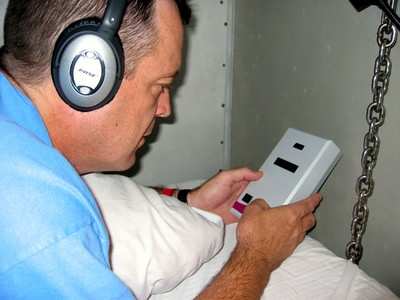
The Psychomotor Vigilance Task (PVT) was developed by David Dinges, a professor of psychology and psychiatry at the University of Pennsylvania. The device administers a three minute test that requires the holder to press a button as quickly as possible after a light flashes.

The test detects cognitive deterioration in the user -- deterioration that could be caused by a number of things such as lack of sleep, stress or alcohol use.

"In high-performance jobs like an astronaut's, you want them as close to optimal performance as you can get them all the time," Dinges said. "The consequences of a human error are grave."

Dinges is working with "aquanauts" living underwater in simulated space conditions, as part of NASA's Extreme Environment Mission Operations in Florida. He is gathering data such as sleep patterns and cortisol levels, which contribute to stress levels, to test the accuracy of his device.

One concern about cognitive testing -- the more a person takes a test, the better they become at fooling it -- isn't a problem with this particular test, Dinges said. Therefore, it can be an effective tool in predicting how well a person can perform a job requiring concentration and quick reflexes.

"I think there's been a need for some kind of fitness of duty parameters," said neurologist Jonathan Clark, a former NASA flight surgeon, who is now with the National Space Biomedical Research Institute.

"It's universally known that just because you feel okay doesn't necessarily mean you are okay."

While the focus has been so far on NASA's uses for the device (shown above), one wonders how long it would be before it might become available to the general public... and, general aviation? Stay tuned.

FMI: www.nasa.gov, www.upenn.edu, www.nsbri.org

Advertisement

More News

ANN's Daily Aero-Term (12.19.25): Ultrahigh Frequency (UHF)

Ultrahigh Frequency (UHF) The frequency band between 300 and 3,000 MHz. The bank of radio frequencies used for military air/ground voice communications. In some instances this may >[...]

NTSB Prelim: Cirrus Design Corp SR22T

During The 7 Second Descent, There Was Another TAWS Alert At Which Time The Engine Remained At Full Power On October 24, 2025 at 2115 mountain daylight time, a Cirrus SR22T, N740TS>[...]

Classic Aero-TV: The Red Tail Project--Carrying the Torch of the Tuskegee Airmen

From 2009 (YouTube Edition): Educational Organization Aims to Inspire by Sharing Tuskegee Story Founding leader Don Hinz summarized the Red Tail Project’s mission in simple, >[...]

Aero-News: Quote of the Day (12.19.25)

“This feels like an important step since space travel for people with disabilities is still in its very early days... I’m so thankful and hope it inspires a change in m>[...]

Airborne 12.17.25: Skydiver Hooks Tail, Cooper Rotax Mount, NTSB v NDAA

Also: New Katanas, Kern County FD Training, IndiGo’s Botched Roster, MGen. Leavitt Named ERAU Dean The Australian Transportation Safety Bureau (ATSB) has wrapped up its inves>[...]

blog comments powered by Disqus



Advertisement

Advertisement

Podcasts

Advertisement

© 2007 - 2025 Web Development & Design by Pauli Systems, LC

