
Australian Researchers Develop Safety System For Drone Rotors | Aero-News Network
Aero-News Network
RSS icon RSS feed
podcast icon MP3 podcast
Subscribe Aero-News e-mail Newsletter Subscribe

Airborne Unlimited -- Most Recent Daily Episodes

Episode Date

Airborne-Monday

Airborne-Tuesday

Airborne-Wednesday Airborne-Thursday

Airborne-Friday

Airborne On YouTube

Airborne-Unlimited-12.01.25

AirborneNextGen-
12.02.25

Airborne-Unlimited-12.03.25

Airborne-FltTraining-12.04.25

AirborneUnlimited-12.05.25

AFE 2025 LIVE MOSAIC Town Hall (Archived): www.airborne-live.net

Wed, Jun 06, 2018

Australian Researchers Develop Safety System For Drone Rotors

Senses Proximity Of Biological Material To The Blades

Researchers at the University of Queensland in Australia are developing a sensor system that is designed to stop a spinning drone rotor blade before it can cause an injury.

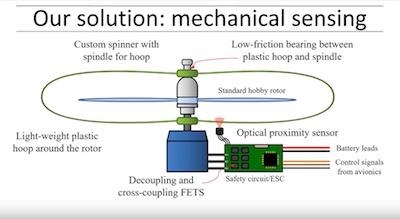
The "Safety Rotor" is a cage around the rotor that spins more slowly than the propeller, and if a biological material is detected, stops the rotor within 0.077 seconds.

IEEE reports on its Spectrum website that the system consists of a plastic hoop that would touch any object, such as a finger, before it is contacted by the rotor blade. The hoops are spun passively by friction against the rotor hub and studded with IR reflectors that interface with an IR detector mounted near the rotor hub. If the IR signal is interrupted, it engages the rotor brake.

The system is expected to cost about $14 and weigh under 22 grams, so drone performance would not be impacted significantly.

According to the researchers:

"The measured latency [of the Safety Rotor’s braking response] was 0.0118 seconds from the triggering event to start of rotor deceleration. The rotor required a further 0.0474 s to come to a complete stop. Ninety percent of the rotational kinetic energy of the rotor (as computed from angular velocity) was dissipated within 0.0216 s of triggering, and 99 percent of the rotational kinetic energy of the rotor was dissipated within 0.032 s.

"The safety functionality of the safety system was tested on the bench using a processed meat “finger” proxy to trigger the hoop, and also applied to an open rotor (without hoop) for comparison. The rotor was spun at hover speed (1100 rads−1) and the finger proxy was introduced into the hoop at 0.36 ms−1 … The rotor and finger motion were captured using a shutter speed of 480 Hz. The rotor came to a stop within 0.077 s, with only light marks on the finger proxy from the impact of the hoop. The rotor was completely stopped by the time the finger reached the rotor plane. In contrast, the tip of the finger proxy introduced to an open rotor was completely destroyed."

(Image from University of Queensland YouTube video)

FMI: Original report, Video

Advertisement

More News

ANN's Daily Aero-Linx (12.03.25)

Aero Linx: American Aviation Historical Society AAHS is dedicated to the preservation and dissemination of the rich heritage of American aviation. Our purpose is to collect, preser>[...]

ANN's Daily Aero-Term (12.03.25): CrewMember (UAS)

CrewMember (UAS) A person assigned to perform an operational duty. A UAS crewmember includes the remote pilot in command, the person manipulating the controls, and visual observers>[...]

NTSB Prelim: Maule M-7-235A

Immediately After The Right Main Tire Contacted The Runway Surface, The Right Main Landing Gear Failed On October 31, 2025, at about 1227 Pacific daylight time, a Maule M-7-235A, N>[...]

Airborne-Flight Training 12.04.25: Ldg Fee Danger, Av Mental Health, PC-7 MKX

Also: IAE Acquires Diamond Trainers, Army Drones, FedEx Pilots Warning, DA62 MPP To Dresden Tech Uni The danger to the flight training industry and our future pilots is clear. Dona>[...]

Aero-News: Quote of the Day (12.04.25)

"On December 3, 2025, at approximately 10:45 a.m., a Thunderbird pilot ejected safely from a F-16C Fighting Falcon aircraft during a training mission over controlled airspace in Ca>[...]

blog comments powered by Disqus



Advertisement

Advertisement

Podcasts

Advertisement

© 2007 - 2025 Web Development & Design by Pauli Systems, LC

