
Pro Aerobatic Pilot Set To Crush World Record For Most Inverted Flat Spins | Aero-News Network
Aero-News Network
RSS icon RSS feed
podcast icon MP3 podcast
Subscribe Aero-News e-mail Newsletter Subscribe

Airborne Unlimited -- Most Recent Daily Episodes

Episode Date

Airborne-Monday

Airborne-Tuesday

Airborne-Wednesday Airborne-Thursday

Airborne-Friday

Airborne On YouTube

Airborne-Unlimited-12.08.25

AirborneNextGen-
12.09.25

Airborne-Unlimited-12.10.25

Airborne-AffordableFlyers-12.11.25

AirborneUnlimited-12.05.25

AFE 2025 LIVE MOSAIC Town Hall (Archived): www.airborne-live.net

Tue, Feb 12, 2019

Pro Aerobatic Pilot Set To Crush World Record For Most Inverted Flat Spins

Spencer Suderman Will Attempt To Break His Own Record Sunday

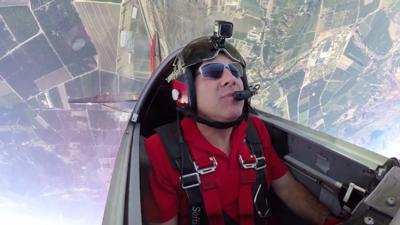
Plummeting toward the ground in a plane that is upside down and spinning is Spencer Suderman’s signature move. The maneuver is called an inverted flat spin, and on February 17, 2019, the professional aerobatic pilot will attempt to smash his own world record by spinning his biplane 120 times over Yuma, Arizona.

Suderman, who lives in St. Augustine, Florida, is an air show performer and two-time Guinness World Records title holder for the most inverted flat spins in an aircraft. For this attempt, Suderman will fly an experimental Pitts Special S-1c. The plane is a different version of the one he used in 2016 to set the current world record of 98 spins. It is lighter and has a flat bottom wing, which lowers the stall speed and should allow it to reach a higher altitude. It also has a smaller engine that was custom built with extreme modifications for the attempt.

Suderman says he wants to do more than just break his own world record, he wants to crush it. “Go big or stay home! I want the world to see that an ordinary person can do amazing things and get so far ahead that no one wants to catch up.”

Suderman will start the maneuver at around 27,000 feet and anticipates it will take between three-and-a-half and four minutes to complete 120 spins. “High altitude flying is inherently risky,” says Suderman. “A failure in the oxygen system at attitude is potentially fatal.” The recovery is set to occur at 2000 feet above ground level, and according to Suderman, if something goes wrong at that point, bailing out high enough for the parachute to work is not guaranteed.

(Source: Spencer Suderman news release. Image from file)

FMI: www.spencersuderman.com

Advertisement

More News

Aero-News: Quote of the Day (12.09.25)

“We respectfully call on the City of Mesa to: 1. Withdraw the landing fee proposal immediately 2. Engage with the aviation community before making decisions that impact safet>[...]

ANN's Daily Aero-Term (12.09.25): High Speed Taxiway

High Speed Taxiway A long radius taxiway designed and provided with lighting or marking to define the path of aircraft, traveling at high speed (up to 60 knots), from the runway ce>[...]

ANN's Daily Aero-Linx (12.09.25)

Aero Linx: International Federation of Airworthiness (IFA) IFA uniquely combines together all those with responsibility for policies, principles and practices concerned with the co>[...]

NTSB Final Report: Diamond Aircraft Ind Inc DA20C1 (A1); Robinson Helicopter R44

Controller’s Expectation That VW02 Would Have Departed Sooner Led To An Inadequate Scan And Loss Of Situational Awareness Analysis: A Robinson R-44 helicopter N744AF, VW02 (V>[...]

ANN FAQ: Q&A 101

A Few Questions AND Answers To Help You Get MORE Out of ANN! 1) I forgot my password. How do I find it? 1) Easy... click here and give us your e-mail address--we'll send it to you >[...]

blog comments powered by Disqus



Advertisement

Advertisement

Podcasts

Advertisement

© 2007 - 2025 Web Development & Design by Pauli Systems, LC

