
NASA Rushes To Find Landing Site For Upcoming Mars Probe | Aero-News Network
Aero-News Network
RSS icon RSS feed
podcast icon MP3 podcast
Subscribe Aero-News e-mail Newsletter Subscribe

Airborne Unlimited -- Most Recent Daily Episodes

Episode Date

Airborne-Monday

Airborne-Tuesday

Airborne-Wednesday Airborne-Thursday

Airborne-Friday

Airborne On YouTube

Airborne-Unlimited-12.01.25

AirborneNextGen-
12.02.25

Airborne-Unlimited-12.03.25

Airborne-FltTraining-12.04.25

AirborneUnlimited-12.05.25

AFE 2025 LIVE MOSAIC Town Hall (Archived): www.airborne-live.net

Sat, Feb 03, 2007

NASA Rushes To Find Landing Site For Upcoming Mars Probe

Phoenix Scheduled To Launch In August

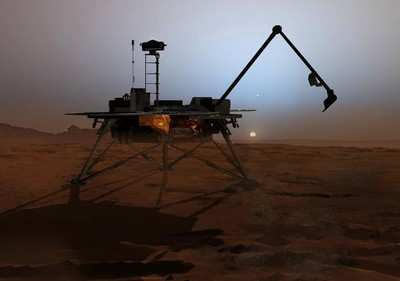
Finding a place to park in the city -- or, a crowded airport ramp -- is an issue nearly all of us have experienced at one time or another. It's also a problem for scientists at NASA who are rushing to find an alternative landing site for an upcoming Mars probe.

The Associated Press reports images taken by the Mars Reconnaissance Orbiter of the planned landing site for the space agency's Phoenix Mars lander showed an unwelcome surprise: large, bus-sized boulders all over the place. Not the most hospitable environment for a $400 million space probe.

Peter Smith of the University of Arizona is NASA's principal investigator on the Phoenix project. He says scientists are studying three possible alternative landing sites, all of which are clustered around Mars' north pole -- an area thought to hold a significant amount of ice just under the soil. Phoenix is equipped with a long drilling arm to collect samples of that soil.

"This is the first mission to actually reach down and get a handful of icy soil and analyze it," Smith said, adding a site dubbed 'Green Valley' for its shallow dip in the Martian surface appears most promising.

Scientists will need to come to a decision soon. Phoenix -- the first probe in NASA's unmanned Mars Scout program -- is set to launch in August. A ruling on a landing site needs to be made by March. Due to the unforeseen delay in finding a suitable landing site, the $386 million project has gone over budget by about $31 million.

Lockheed Martin built the probe, which was originally set to fly as part of the Mars Global Surveyor program in 2001. However, the program was halted when the Mars Polar Lander mysteriously disappeared in 1999.

A NASA investigation later determined that loss was due to a premature shutoff of the Polar Lander's engine... and Phoenix received a new chance to fly.

FMI: www.nasa.gov, http://phoenix.lpl.arizona.edu

Advertisement

More News

ANN's Daily Aero-Term (12.04.25): Cooperative Surveillance

Cooperative Surveillance Any surveillance system, such as secondary surveillance radar (SSR), wide-area multilateration (WAM), or ADS-B, that is dependent upon the presence of cert>[...]

ANN's Daily Aero-Linx (12.04.25)

Aero Linx: OX5 Aviation Pioneers Incorporated in 1955 as a Pa 501 (c)(3) Not for Profit Corporation, the OX5 Aviation Pioneers is dedicated to bringing before the public the accomp>[...]

NTSB Prelim: Extra Flugzeugproduktions EA 300/SC

The Pilot Appeared To Regain Control After Six Rotations And Attempted To “Fly Out” Inverted But Had Insufficient Altitude On November 8, 2025, at 1038 eastern standard>[...]

Classic Aero-TV: The Bally Bomber - The All Time Ultimate Warbird Replica?

From 2018 (YouTube Edition): Aero-News Talks With The Airplane's Builder One of the many unique airplanes at AirVenture 2018 was a 1/3-scale B-17 bomber built by Jack Bally, who ta>[...]

ANN's Daily Aero-Linx (12.05.25)

Aero Linx: Society of U.S. Army Flight Surgeons (SoUSAFS) The Society of US Army Flight Surgeons (SoUSAFS) serves to advance the science and art of Aerospace Medicine and its allie>[...]

blog comments powered by Disqus



Advertisement

Advertisement

Podcasts

Advertisement

© 2007 - 2025 Web Development & Design by Pauli Systems, LC

