Such Spacecraft Closer To Reality After A Student Experiment Aboard A Recent NASA-Sponsored Microgravity Flight
Vehicles that could land on comets and asteroids and then move around to explore took a step closer to reality through a student experiment aboard a recent NASA-sponsored microgravity flight.
NASA’s exploration of Near Earth Objects has thus far entailed sending systems that studied the immediate area near where they landed on, or flew by, asteroids and comets. Draper Laboratory hopes to develop vehicles that could explore more terrain, expanding scientists’ ability to examine materials that are relatively unchanged since the formation of the universe, and search for valuable natural resources for use in space operations or on Earth.
Hopping vehicles could also play a key role in exploring Near Earth Objects prior to potential landings from astronauts by exploring multiple locations on an asteroid. President Barack Obama has cited human exploration of an asteroid as a desirable destination in preparation for a manned mission to Mars, and the Review of Human Space Flight Plans Committee (also known as the Augustine Commission) listed human exploration of Near Earth Objects as a potential stepping stone towards human settlements beyond Earth.
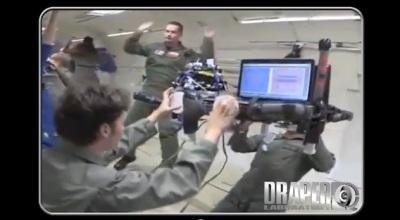
Draper has been working with graduate and undergraduate students from the Massachusetts Institute of Technology on TALARIS (Terrestrial Artificial Lunar and Reduced Gravity Simulator), a prototype for a vehicle that could land on planets like the Moon and Mars and “hop” around to explore. The hopping concept would complement wheeled vehicles by covering far more ground, and having the ability to fly over obstacles or into areas that rovers could not reach. In the case of asteroids and comets, the microgravity environment would likely cause a wheeled vehicle to propel itself away from the object’s surface, but the rockets aboard a hopper would enable the spacecraft to conduct multiple take-offs and landings.
Developing the guidance, navigation and control (GN&C) software needed to guide a hopping vehicle safely and precisely around a planet, asteroid or comet is a crucial part of the concept. Draper has developed GN&C solutions for NASA beginning with the Apollo missions, and continuing today with the International Space Station and other programs. Draper has been developing the GN&C technology for hopping, while the MIT students have worked on developing the prototype vehicle for demonstrations.
The recent microgravity flight was sponsored by Johnson Space Center’s Microgravity University. Draper funded the students’ work to modify TALARIS in preparation for the demonstration, as well as the students’ travel costs from Cambridge to Houston, where the aircraft took off.
The flight enabled the students to test GN&C software under gravitational conditions similar to those found on a Near Earth Object without the vibration and noise errors introduced by electric ducted fans that had been used to simulate microgravity during laboratory testing on the ground.
While NASA’s safety restrictions kept the students from using TALARIS’ thrusters inside the aircraft used for the microgravity flights, the students pushed their prototype while TALARIS’ software processed data gathered by its sensors.
The students hope to conduct a more advanced test aboard another microgravity flight next year using low-power thrusters that could comply with NASA’s safety requirements.
(Image source Draper YouTube video of microgravity flight)



 ANN's Daily Aero-Term (12.08.25): Decision Altitude (DA)


 See All