Tech That Enables New Missions And Capability With A Software Push Will Be Ready For Launch This Year
Lockheed Martin has announced a new generation of space technology launching this year that will allow satellites to change their missions in orbit. Satellites that launched one, ten or even fifteen years ago largely have the same capability they had when they lifted off. That's changing with new architecture that will let users add capability and assign new missions with a software push, just like adding an app on a smartphone. This new tech, called SmartSat, is a software-defined satellite architecture that will boost capability for payloads on several pioneering nanosats ready for launch this year.
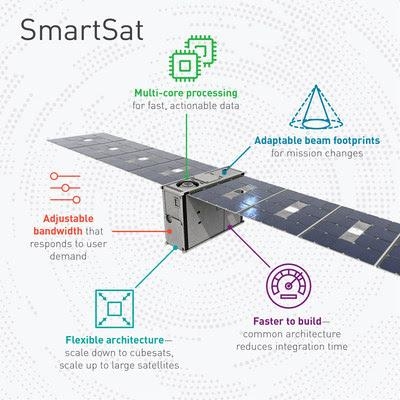
"Imagine a new type of satellite that acts more like a smartphone. Add a SmartSat app to your satellite in-orbit, and you've changed the mission," said Rick Ambrose, executive vice president of Lockheed Martin Space. "We are the first to deploy this groundbreaking technology on multiple missions. SmartSat will give our customers unparalleled resiliency and flexibility for changing mission needs and technology, and it unlocks even greater processing power in space."
This year Lockheed Martin is integrating SmartSat technology on ten programs and counting, including the Linus and Pony Express nanosats, which will be the first to launch. These are rapid-prototype, testbed satellites using internal research and development funding, ready for 2019 launches on the first LM 50 nanosatellite buses:
The Linus project delivers two 12U cubesats performing a technology demonstration mission, validating SmartSat capabilities as well as 3D-printed spacecraft components.
Pony Express builds multiple 6U satellites destined for a low earth orbit and will space qualify state-of-the-art networking technologies. Pony Express 1 is a pathfinder for a software-defined payload that will test cloud computing infrastructure and was developed in nine months. Follow-on Pony Express missions will prove out RF-enabled swarming formations and space-to-space networking.
"SmartSat is a major step forward in our journey to completely transform the way we design, build and deliver satellites," said Ambrose. "The LM 50 bus is the perfect platform for testing this new, groundbreaking technology. We're self-funding these missions to demonstrate a number of new capabilities that can plug into any satellite in our fleet, from the LM 50 nanosat to our flagship LM 2100. And the same technology not only plugs into ground stations, improving space-ground integration, it will one day connect directly with planes, ships and ground vehicles, connecting front-line users to the power of space like never before."
Cyber security is at the core of this new technology. SmartSat-enabled satellites can reset themselves faster, diagnose issues with greater precision and back each other up when needed, significantly enhancing resiliency. Satellites can also better detect and defend against cyber threats autonomously, and on-board cyber defenses can be updated regularly to address new threats.
SmartSat uses a hypervisor to securely containerize virtual machines. It's a technology that lets a single computer operate multiple servers virtually to maximize memory, on-board processing and network bandwidth. It takes advantage of multi-core processing, something new to space. That lets satellites process more data in orbit so they can beam down just the most critical and relevant information—saving bandwidth costs and reducing the burden on ground station analysts, and ultimately opening the door for tomorrow's data centers in space.
SmartSat uses a high-power, radiation-hardened computer developed by the National Science Foundation's Center for Space, High-performance, and Resilient Computing, or SHREC. Lockheed Martin helps fund SHREC research, and in turn gains access to world-class technologies and student researchers.
(Infographic provided with Lockheed Martin news release)



 ANN's Daily Aero-Term (12.19.25): Ultrahigh Frequency (UHF)


 See All