Sat, Aug 11, 2012
First Weapon Released In Flight Was A 1,000 Pound JDAM Bomb
The F-35 Lightning II accomplished a significant test milestone August 8 when the aircraft successfully released a weapon in flight. BF-3, a short take-off and vertical landing F-35 variant, executed an inert 1,000-pound GBU-32 Joint Direct Attack Munition (JDAM) separation weapon over water in an Atlantic test range while traveling at 400 knots at an altitude of 4,200 feet.
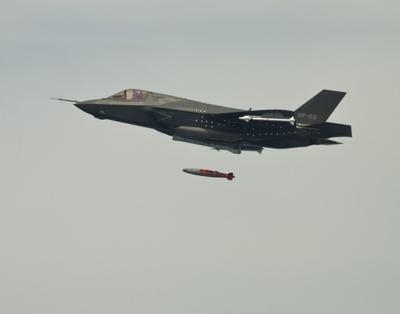
"While this weapons separation test is just one event in a series of hundreds of flights and thousands of test points that we are executing this year, it does represent a significant entry into a new phase of testing for the F-35 program," said Navy Capt. Erik Etz, director of test for F-35 naval variants. "Today's release of a JDAM was the result of extraordinary effort by our team of maintainers, engineers, pilots and others who consistently work long hours to deliver F-35 warfighting capability to the U.S. services and our international partners."
The release was the first time for any version of the F-35 to conduct an airborne weapon separation, as well as the first from an internal weapons bay for a fighter aircraft designated for the U.S. Marine Corps, the United Kingdom and Italy. The milestone marks the start of validating the F-35's capability to employ precision weapons and allow pilots to engage the enemy on the ground and in the air.
"[Using an internal weapons bay] speaks to how much capability the JSF is going to bring to the troops," said Dan Levin, Lockheed Martin test pilot for the mission. "Stealth, fifth-generation avionics and precision weapons ... coupled with the flexible mission capability of the short take-off and vertical landing F-35B is going to be huge for our warfighters."
An aerial weapons separation test checks for proper release of the weapon from its carriage system and trajectory away from the aircraft. It is the culmination of a significant number of prerequisite tests, including ground fit checks, ground pit drops and aerial captive carriage and environment flights to ensure the system is working properly before expanding the test envelope in the air.
Aircraft and land-based test monitoring systems collected data from the successful separation, which is in review at the F-35 integrated test force at Naval Air Station Patuxent River.
The F-35B is the variant of the Joint Strike Fighter designed for use by U.S. Marine Corps, as well as F-35 international partners in the United Kingdom and Italy.
More News
How To Get A Story On Aero-TV News/Feature Programming How do I submit a story idea or lead to Aero-TV? If you would like to submit a story idea or lead, please contact Jim Campbel>[...]
“As the excitement builds for the world of flight returning to Oshkosh in 2026, we wanted to ensure that advance tickets are available for those who enjoy giving AirVenture t>[...]
North Atlantic High Level Airspace (NAT HLA) That volume of airspace (as defined in ICAO Document 7030) between FL 285 and FL 420 within the Oceanic Control Areas of Bodo Oceanic, >[...]
Also: Cosmonaut Kicked Out, Airbus Scales Back, AF Silver Star, Russian A-60 Clobbered A Samaritan’s Purse humanitarian flight was hijacked on Tuesday, December 2, while atte>[...]
Also: IAE Acquires Diamond Trainers, Army Drones, FedEx Pilots Warning, DA62 MPP To Dresden Tech Uni The danger to the flight training industry and our future pilots is clear. Dona>[...]



 ANN FAQ: Contributing To Aero-TV


 See All