Fri, Dec 12, 2008
Canadian Telecom Satellite Was Sixth Launch For 2008
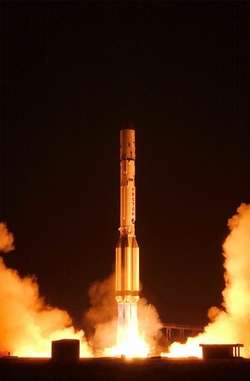 International Launch Services (ILS)
successfully carried the Ciel II satellite into space for the Ciel
Satellite Group of Canada Wednesday onboard a Russian Proton Breeze
M heavy-lift launch vehicle.
International Launch Services (ILS)
successfully carried the Ciel II satellite into space for the Ciel
Satellite Group of Canada Wednesday onboard a Russian Proton Breeze
M heavy-lift launch vehicle.
This was the sixth launch of the year, and 49th overall, for
ILS. It is the 340th launch for the Proton system since its
inception. The Proton Breeze M vehicle is built by Khrunichev Space
Center of Moscow.
The Proton vehicle lifted off from the Baikonur Cosmodrome at
7:43 pm local time (8:43 am EST). The launch vehicle carried the 5
1/2-ton satellite for 9 hours and 12 minutes, releasing it into
geosynchronous transfer orbit. Ciel II is a Spacebus 4000 model
built by Thales Alenia Space. The satellite will ultimately be
moved to 129 degrees West longitude, where it will deliver digital
television services to Canada and the contiguous United States.
"I would like to thank Ciel and SES for placing their confidence
and trust in ILS and the Proton Breeze M," said ILS president Frank
McKenna. "We entered into this launch contract in February of last
year and set the launch for December 2008; this supports ILS's
long-standing commitment to precise, on-time delivery for our
customers. Ciel II is the 16th satellite that ILS has launched for
the SES family, a successful, on-going collaboration that spans
more than a dozen years."
A US-based company, ILS holds exclusive rights to market the
Russian Proton to commercial satellite operators worldwide.
Wednesday's launch marks the third successful liftoff in a row for
the heavy booster, following the failed March 15 launch of the
AMC-14 satellite from the Baikonur.
During that mission, the Breeze M upper stage shut down two
minutes before the end of the planned second burn of its engine.
The satellite survived, and was released into a lower-than-planned
orbit. It was the third failure in as many years for the Proton M,
and the second in six months.
A Russian State Commission determined the failure was caused by
a ruptured exhaust gas conduit, which led to a shutdown of the
turbo pump feeding the Breeze M engine. The booster was cleared for
return to flight in June.
More News
“We respectfully call on the City of Mesa to: 1. Withdraw the landing fee proposal immediately 2. Engage with the aviation community before making decisions that impact safet>[...]
High Speed Taxiway A long radius taxiway designed and provided with lighting or marking to define the path of aircraft, traveling at high speed (up to 60 knots), from the runway ce>[...]
Aero Linx: International Federation of Airworthiness (IFA) IFA uniquely combines together all those with responsibility for policies, principles and practices concerned with the co>[...]
Controller’s Expectation That VW02 Would Have Departed Sooner Led To An Inadequate Scan And Loss Of Situational Awareness Analysis: A Robinson R-44 helicopter N744AF, VW02 (V>[...]
A Few Questions AND Answers To Help You Get MORE Out of ANN! 1) I forgot my password. How do I find it? 1) Easy... click here and give us your e-mail address--we'll send it to you >[...]



 Aero-News: Quote of the Day (12.09.25)


 See All