
RS-25 Engine Testing Blazes Forward For NASA's SLS | Aero-News Network
Aero-News Network
RSS icon RSS feed
podcast icon MP3 podcast
Subscribe Aero-News e-mail Newsletter Subscribe

Airborne Unlimited -- Most Recent Daily Episodes

Episode Date

Airborne-Monday

Airborne-Tuesday

Airborne-Wednesday Airborne-Thursday

Airborne-Friday

Airborne On YouTube

Airborne-Unlimited-12.08.25

AirborneNextGen-
12.09.25

Airborne-Unlimited-12.10.25

Airborne-AffordableFlyers-12.11.25

AirborneUnlimited-12.12.25

AFE 2025 LIVE MOSAIC Town Hall (Archived): www.airborne-live.net

Tue, Jan 13, 2015

RS-25 Engine Testing Blazes Forward For NASA's SLS

Former Shuttle Main Engine To Boost The Agency's Newest Rocket

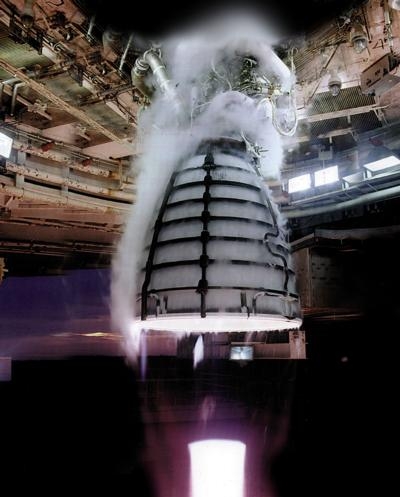
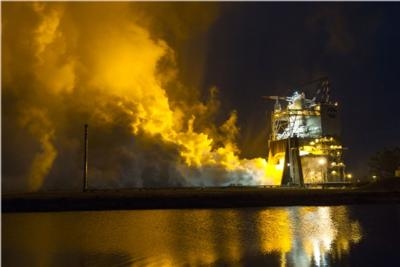
The new year is off to a hot start for NASA's Space Launch System (SLS). The engine that will drive America's next great rocket to deep space blazed through its first successful test Jan. 9 at the agency's Stennis Space Center near Bay St. Louis, Mississippi.

The RS-25, formerly the space shuttle main engine, fired up for 500 seconds on the A-1 test stand at Stennis, providing NASA engineers critical data on the engine controller unit and inlet pressure conditions. This is the first hot fire of an RS-25 engine since the end of space shuttle main engine testing in 2009. Four RS-25 engines will power SLS on future missions.

"We’ve made modifications to the RS-25 to meet SLS specifications and will analyze and test a variety of conditions during the hot fire series,” said Steve Wofford, manager of the SLS Liquid Engines Office at NASA's Marshall Space Flight Center in Huntsville, Alabama, where the SLS Program is managed. "The engines for SLS will encounter colder liquid oxygen temperatures than shuttle; greater inlet pressure due to the taller core stage liquid oxygen tank and higher vehicle acceleration; and more nozzle heating due to the four-engine configuration and their position in-plane with the SLS booster exhaust nozzles.”

The engine controller unit, the "brain" of the engine, allows communication between the vehicle and the engine, relaying commands to the engine and transmitting data back to the vehicle. The controller also provides closed-loop management of the engine by regulating the thrust and fuel mixture ratio while monitoring the engine's health and status. The new controller will use updated hardware and software configured to operate with the new SLS avionics architecture.

"This first hot-fire test of the RS-25 engine represents a significant effort on behalf of Stennis Space Center’s A-1 test team," said Ronald Rigney, RS-25 project manager at Stennis. "Our technicians and engineers have been working diligently to design, modify and activate an extremely complex and capable facility in support of RS-25 engine testing."

Testing will resume in April after upgrades are completed on the high pressure industrial water system, which provides cool water for the test facility during a hot fire test. Eight tests, totaling 3,500 seconds, are planned for the current development engine. Another development engine later will undergo 10 tests, totaling 4,500 seconds. The second test series includes the first test of new flight controllers, known as green running.

The first flight test of the SLS will feature a configuration for a 77-ton lift capacity and carry an uncrewed Orion spacecraft beyond low-Earth orbit to test the performance of the integrated system. As the SLS is upgraded, it will provide an unprecedented lift capability of 143 tons to enable missions even farther into our solar system.

(Images provided by NASA)

FMI: www.nasa.gov

Advertisement

More News

Aero-News: Quote of the Day (12.09.25)

“We respectfully call on the City of Mesa to: 1. Withdraw the landing fee proposal immediately 2. Engage with the aviation community before making decisions that impact safet>[...]

ANN's Daily Aero-Term (12.09.25): High Speed Taxiway

High Speed Taxiway A long radius taxiway designed and provided with lighting or marking to define the path of aircraft, traveling at high speed (up to 60 knots), from the runway ce>[...]

ANN's Daily Aero-Linx (12.09.25)

Aero Linx: International Federation of Airworthiness (IFA) IFA uniquely combines together all those with responsibility for policies, principles and practices concerned with the co>[...]

NTSB Final Report: Diamond Aircraft Ind Inc DA20C1 (A1); Robinson Helicopter R44

Controller’s Expectation That VW02 Would Have Departed Sooner Led To An Inadequate Scan And Loss Of Situational Awareness Analysis: A Robinson R-44 helicopter N744AF, VW02 (V>[...]

ANN FAQ: Q&A 101

A Few Questions AND Answers To Help You Get MORE Out of ANN! 1) I forgot my password. How do I find it? 1) Easy... click here and give us your e-mail address--we'll send it to you >[...]

blog comments powered by Disqus



Advertisement

Advertisement

Podcasts

Advertisement

© 2007 - 2025 Web Development & Design by Pauli Systems, LC

