
Agriculture Official Defends Tanker Decision | Aero-News Network
Aero-News Network
RSS icon RSS feed
podcast icon MP3 podcast
Subscribe Aero-News e-mail Newsletter Subscribe

Airborne Unlimited -- Most Recent Daily Episodes

Episode Date

Airborne-Monday

Airborne-Tuesday

Airborne-Wednesday Airborne-Thursday

Airborne-Friday

Airborne On YouTube

Airborne-Unlimited-12.01.25

AirborneNextGen-
12.02.25

Airborne-Unlimited-12.03.25

Airborne-AffordableFlyers-11.20.25

AirborneUnlimited-11.21.25

LIVE MOSAIC Town Hall (Archived): www.airborne-live.net

Fri, Jun 04, 2004

Agriculture Official Defends Tanker Decision

Promises $66 Million On More Firefighting Aircraft

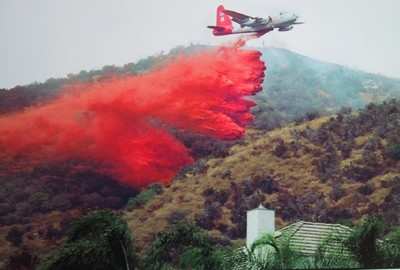
A top official at the Department of Agriculture said Wednesday "no prudent person" would have continued to fly aging firefighting tankers after the government decided there was no way to guarantee that they're airworthy.

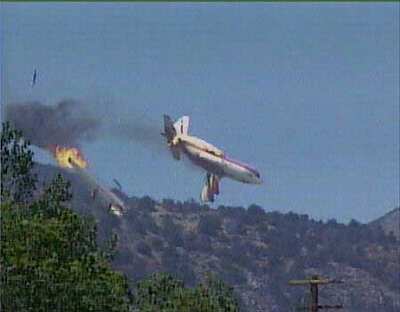
Agriculture Undersecretary Mark Rey told the Missoulian newspaper in Montana that the decision to ground 33 tankers, some of them more than six decades old, came in the wake of the NTSB's report on a pair of C130 crashes in 2002. And Rey hinted that the US Forest Service could have gone much further.

"If we had decided to be even more risk aversive, we could have stood down everything," he told reporters. "But there are differences between these aircraft. The single-engine air tankers, for example, have civil missions comparable to their firefighting mission. When they're not fighting fire, most of them are crop dusters.

"After the NTSB report was issued, we were faced with a straightforward, albeit not very simple, question," Rey said. "Would any prudent person continue to fly the large air tankers, given the availability of alternative aircraft that are demonstrably safer to operate?"

The answer, he said, was "no."

Still, Rey admitted that the blanket rule might not be fair to all tanker operators, some of which are now up to their necks in financial hot water as a result of the grounding decision. Many of them deserve a chance "to show why their planes are different," he said.

Wednesday, the FAA sent operators of the grounded aircraft a laundry list of things aircraft owners can do to prove their planes are still airworthy.

"We are motivated to review these planes and, if possible, to bring them back," Rey said. "If we weren't so motivated, we wouldn't be going through this exercise with the FAA." But Rey warned that "being motivated and being realistic are different. It is unlikely that all the air tankers will come back, and it may be unlikely that the majority will come back."

In the meantime, hoping to quell the rising concerns of lawmakers representing western states at the onset of what's predicted to be a chaotic fire season, Rey promised more help is on the way. The government is putting another 100 aircraft on the fire lines -- including helicopters, single-engine retardant aircraft and two Canadian CL215s -- to replace the grounded air tankers. That will cost Washington an extra $66 million this year alone.

FMI: www.faa.gov

Advertisement

More News

ANN's Daily Aero-Term (12.01.25): Convective SIGMET

Convective SIGMET A weather advisory concerning convective weather significant to the safety of all aircraft. Convective SIGMETs are issued for tornadoes, lines of thunderstorms, e>[...]

ANN's Daily Aero-Linx (12.01.25)

Aero Linx: United Flying Octogenarians WELCOME to a most extraordinary group of aviators, the United Flying Octogenarians (UFO). Founded in 1982 with just a handful of pilots, we h>[...]

NTSB Final Report: Remos Aircraft GmbH Remos GX

Pilot’s Decision To Attempt Takeoff With Frost Covering The Airplane’s Wings Analysis: The pilot of the light sport airplane was preparing to depart for a cross-country>[...]

Aero-News: Quote of the Day (12.02.25)

“We’ve paid for the cable line’s repair for the customer and have apologized for the inconvenience this caused them...” Source: Some followup info from an A>[...]

ANN's Daily Aero-Term (12.02.25): Coupled Approach

Coupled Approach An instrument approach performed by the aircraft autopilot, and/or visually depicted on the flight director, which is receiving position information and/or steerin>[...]

blog comments powered by Disqus



Advertisement

Advertisement

Podcasts

Advertisement

© 2007 - 2025 Web Development & Design by Pauli Systems, LC

