
VSS Unity Successfully Completes High Speed Glide Flight | Aero-News Network
Aero-News Network
RSS icon RSS feed
podcast icon MP3 podcast
Subscribe Aero-News e-mail Newsletter Subscribe

Airborne Unlimited -- Most Recent Daily Episodes

Episode Date

Airborne-Monday

Airborne-Tuesday

Airborne-Wednesday Airborne-Thursday

Airborne-Friday

Airborne On YouTube

Airborne-Unlimited-12.08.25

AirborneNextGen-
12.09.25

Airborne-Unlimited-12.10.25

Airborne-AffordableFlyers-12.11.25

AirborneUnlimited-12.12.25

AFE 2025 LIVE MOSAIC Town Hall (Archived): www.airborne-live.net

Sat, Jan 13, 2018

VSS Unity Successfully Completes High Speed Glide Flight

Seventh Unpowered Flight Accelerated To Mach 0.9

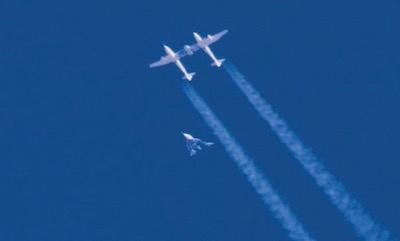
VSS Unity has successfully completed her seventh glide flight, according to Virgin Galactic.

In the few months since Unity's last flight, the team has worked through a planned period of focused ground time. This involved extensive analysis, testing and small modifications to ensure vehicle readiness for the higher loads and forces of powered test flight. That work was tested Thursday by pushing Unity’s atmospheric capabilities hard, touching top-end glide speeds as pilots Mark ‘Forger’ Stucky and Michael ‘Sooch’ Masucci completed a busy test card.

Along with confirming the work that has taken place on the ground, the glide flight tested transonic flight performance, stability and control. After release from mothership VMS Eve, the spaceship was immediately pushed into a sharp descent, accelerating to Mach 0.9 which is around the maximum airspeed that can achieved without igniting the rocket motor.

At this stage of the glide flight program, each flight is essentially a dry run for rocket-powered test flights. Where possible the team replicates those powered flight conditions by, for example, adding water ballast to simulate the weight and positioning of the rocket motor. As during previous flights, the water ballast was jettisoned at around 22,000 feet, allowing the pilots to complete the flight and land in a lighter configuration, again simulating the conditions which will apply during space flight. Also as a precursor to powered flight, VSS Unity flew with her thermal protection system (TPS) fully applied. This ensures that heat loads generated by air friction during rocket-powered boost and supersonic re-entry cause no damage to the vehicle.

The VMS Eve crew included CJ Sturckow, Kelly Latimer and Richard Starke.

(Image provided with Virgin Galactic news release)

FMI: www.virgingalactic.com

Advertisement

More News

ANN's Daily Aero-Linx (12.12.25)

Aero Linx: Commercial Aviation Safety Team (CAST) Founded in 1997, the Commercial Aviation Safety Team (USCAST) has developed an integrated, data-driven strategy to reduce the comm>[...]

ANN's Daily Aero-Term (12.12.25): Land And Hold Short Operations

Land And Hold Short Operations Operations that include simultaneous takeoffs and landings and/or simultaneous landings when a landing aircraft is able and is instructed by the cont>[...]

ANN FAQ: How Do I Become A News Spy?

We're Everywhere... Thanks To You! Even with the vast resources and incredibly far-reaching scope of the Aero-News Network, every now and then a story that should be reported on sl>[...]

NTSB Final Report: Cirrus Design Corp SF50

Pilot’s Inadvertent Use Of The Landing Gear Control Handle Instead Of The Flaps Selector Switch During The Landing Rollout Analysis: The pilot reported that during the landin>[...]

Airborne 12.08.25: Samaritan’s Purse Hijack, FAA Med Relief, China Rocket Fail

Also: Cosmonaut Kicked Out, Airbus Scales Back, AF Silver Star, Russian A-60 Clobbered A Samaritan’s Purse humanitarian flight was hijacked on Tuesday, December 2, while atte>[...]

blog comments powered by Disqus



Advertisement

Advertisement

Podcasts

Advertisement

© 2007 - 2025 Web Development & Design by Pauli Systems, LC

