
NASA's New Horizons Mission Reveals Entirely New Kind Of World | Aero-News Network
Aero-News Network
RSS icon RSS feed
podcast icon MP3 podcast
Subscribe Aero-News e-mail Newsletter Subscribe

Airborne Unlimited -- Most Recent Daily Episodes

Episode Date

Airborne-Monday

Airborne-Tuesday

Airborne-Wednesday Airborne-Thursday

Airborne-Friday

Airborne On YouTube

Airborne-Unlimited-12.01.25

AirborneNextGen-
12.02.25

Airborne-Unlimited-12.03.25

Airborne-FltTraining-12.04.25

AirborneUnlimited-12.05.25

AFE 2025 LIVE MOSAIC Town Hall (Archived): www.airborne-live.net

Mon, Jan 07, 2019

NASA's New Horizons Mission Reveals Entirely New Kind Of World

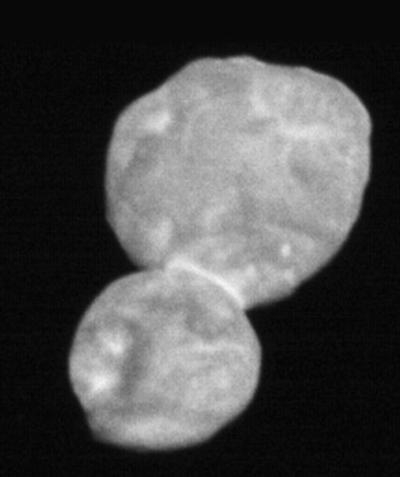
Images Of The Kuiper Belt Object Ultima Thule Unveil The Very First Stages Of Solar System's History

Scientists from NASA's New Horizons mission released the first detailed images of the most distant object ever explored — the Kuiper Belt object nicknamed Ultima Thule. Its remarkable appearance, unlike anything we've seen before, illuminates the processes that built the planets four and a half billion years ago.

"This flyby is a historic achievement," said New Horizons Principal Investigator Alan Stern of the Southwest Research Institute in Boulder, Colorado. "Never before has any spacecraft team tracked down such a small body at such high speed so far away in the abyss of space. New Horizons has set a new bar for state-of-the-art spacecraft navigation."

The new images — taken from as close as 17,000 miles on approach — revealed Ultima Thule as a "contact binary," consisting of two connected spheres. End to end, the world measures 19 miles in length. The team has dubbed the larger sphere "Ultima" (12 miles across) and the smaller sphere "Thule" (9 miles across).

The team says that the two spheres likely joined as early as 99 percent of the way back to the formation of the solar system, colliding no faster than two cars in a fender-bender.

"New Horizons is like a time machine, taking us back to the birth of the solar system. We are seeing a physical representation of the beginning of planetary formation, frozen in time," said Jeff Moore, New Horizons Geology and Geophysics team lead. "Studying Ultima Thule is helping us understand how planets form — both those in our own solar system and those orbiting other stars in our galaxy."

Data from the New Year's Day flyby will continue to arrive over the next weeks and months, with much higher resolution images yet to come.

"In the coming months, New Horizons will transmit dozens of data sets to Earth, and we'll write new chapters in the story of Ultima Thule — and the solar system," said Helene Winters, New Horizons Project Manager.

(Image provided with NASA news release)

FMI: www.nasa.gov

Advertisement

More News

ANN's Daily Aero-Term (12.04.25): Cooperative Surveillance

Cooperative Surveillance Any surveillance system, such as secondary surveillance radar (SSR), wide-area multilateration (WAM), or ADS-B, that is dependent upon the presence of cert>[...]

ANN's Daily Aero-Linx (12.04.25)

Aero Linx: OX5 Aviation Pioneers Incorporated in 1955 as a Pa 501 (c)(3) Not for Profit Corporation, the OX5 Aviation Pioneers is dedicated to bringing before the public the accomp>[...]

NTSB Prelim: Extra Flugzeugproduktions EA 300/SC

The Pilot Appeared To Regain Control After Six Rotations And Attempted To “Fly Out” Inverted But Had Insufficient Altitude On November 8, 2025, at 1038 eastern standard>[...]

Classic Aero-TV: The Bally Bomber - The All Time Ultimate Warbird Replica?

From 2018 (YouTube Edition): Aero-News Talks With The Airplane's Builder One of the many unique airplanes at AirVenture 2018 was a 1/3-scale B-17 bomber built by Jack Bally, who ta>[...]

ANN's Daily Aero-Linx (12.05.25)

Aero Linx: Society of U.S. Army Flight Surgeons (SoUSAFS) The Society of US Army Flight Surgeons (SoUSAFS) serves to advance the science and art of Aerospace Medicine and its allie>[...]

blog comments powered by Disqus



Advertisement

Advertisement

Podcasts

Advertisement

© 2007 - 2025 Web Development & Design by Pauli Systems, LC

