Fri, Sep 07, 2012
Redesigning Hook Point For Carrier-Based X-47B UCAS
The Fleet Readiness Center South West (FRCSW) in California surpassed the call of its traditional line of work to rapidly manufacture parts for a new, unmanned demonstrator aircraft. In late spring, a team from Patuxent River, MD, called on FRCSW at Naval Air Station North Island to redesign the hook point for the first unmanned aircraft designed to operate in and around an aircraft carrier — the X-47B Unmanned Combat Air System (UCAS).
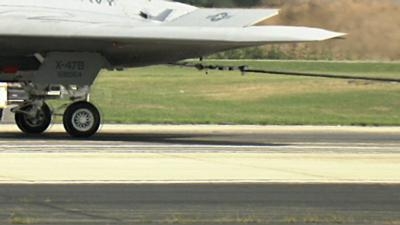
To land on the flight deck of a carrier, aircraft need a tailhook to catch one of four arresting wires. When unsuccessful roll-in arrestment tests of the X-47B revealed the need for a modified hook point, the team needed to come up with a plan to make the modifications in order to perform arrested landings and catapult launches this fall. “We reached out to the team at North Island because of their proven history of providing critically needed aircraft components with very short response times,” said Capt. Jaime Engdahl, Navy UCAS program manager at Pax River. “They have repaired, modified and delivered thousands of high quality aircraft components to the fleet. We knew they could get the job done.”
Seventy years earlier, North Island personnel were presented with a similar challenge. Prior to the Battle of Midway, a lack of tail hooks, and the inability of the American industrial base to produce them, spurred FRCSW, then known as Overhaul and Repair, to develop a way to forge and manufacture 150 hook throats in just 30 days. The team at FRCSW did not hesitate when asked to redesign this instrumental X-47B component. Within a few weeks of receiving the initial request from the UCAS team, the FRC signed a formal work order July 10, anticipating the manufacturing and shipping process would take up to one month.

The UCAS and FRC teams worked together to overcome a series of complications to ensure the hook points were completed as quickly as possible. For example, machining the first steel part took longer than expected. As a result, the FRC made an investment in a more efficient machine to decrease cycle times. In less than two months, despite the design challenges, the UCAS team received the completed parts from FRCSW in early August, avoiding costly delays and allowing the team to proceed with aircraft testing. Since then, the X-47B successfully engaged the arresting gear with the redesigned hook point during three separate roll-in arrestment tests.
“The hook point is a fracture critical safety item so you’ve got to do the job right. You have to create them correctly,” said Mike Grice, FRCSW Systems Engineering department head.
Engdahl visited North Island last month and personally thanked the dozens of employees who worked extended hours for nearly two months to support this effort. The FRCSW team made a huge contribution to the UCAS program that will greatly impact naval aviation, he added.
(Images provided by the U.S. Navy)
More News
Cooperative Surveillance Any surveillance system, such as secondary surveillance radar (SSR), wide-area multilateration (WAM), or ADS-B, that is dependent upon the presence of cert>[...]
Aero Linx: OX5 Aviation Pioneers Incorporated in 1955 as a Pa 501 (c)(3) Not for Profit Corporation, the OX5 Aviation Pioneers is dedicated to bringing before the public the accomp>[...]
The Pilot Appeared To Regain Control After Six Rotations And Attempted To “Fly Out” Inverted But Had Insufficient Altitude On November 8, 2025, at 1038 eastern standard>[...]
From 2018 (YouTube Edition): Aero-News Talks With The Airplane's Builder One of the many unique airplanes at AirVenture 2018 was a 1/3-scale B-17 bomber built by Jack Bally, who ta>[...]
Aero Linx: Society of U.S. Army Flight Surgeons (SoUSAFS) The Society of US Army Flight Surgeons (SoUSAFS) serves to advance the science and art of Aerospace Medicine and its allie>[...]



 ANN's Daily Aero-Term (12.04.25): Cooperative Surveillance


 See All