Osprey Completes Final Shipboard Developmental Testing | Aero-News Network
Aero-News Network
RSS icon RSS feed
podcast icon MP3 podcast
Subscribe Aero-News e-mail Newsletter Subscribe

Airborne Unlimited -- Most Recent Daily Episodes

Episode Date

Airborne-Monday

Airborne-Tuesday

Airborne-Wednesday Airborne-Thursday

Airborne-Friday

Airborne On YouTube

Airborne-Unlimited-08.25.25

Airborne-NextGen-08.26.25

AirborneUnlimited-08.27.25

Airborne-AffordableFlyers-08.28.25

AirborneUnlimited-08.22.25

Tue, Dec 07, 2004

Osprey Completes Final Shipboard Developmental Testing

Important Step Toward Op Eval Next Year

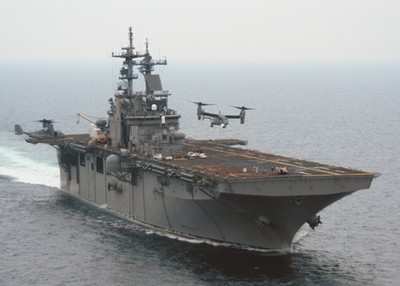
The V-22 Integrated Test Team conducted Shipboard Suitability Phase IVc for ten days beginning on November 12. This was the fourth and final underway period for the ITT since the program’s return to flight in May of 2002. Phase IVc’s successful completion was an important step on the path toward the Osprey’s operational evaluation early next year.

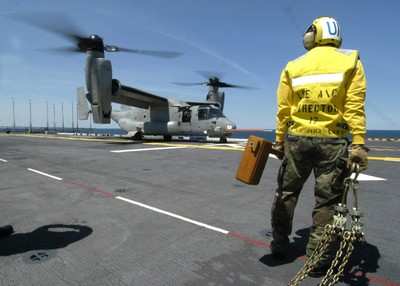
The primary objective of this phase was to complete interaction testing between a V-22 parked on the flight deck and another V-22 hovering in front of it. Additional test objectives included flight envelope expansion for all port side landing spots aboard the LHD, developing a night short takeoff envelope, and evaluating the latest flight control software version.

“The team was able to get a lot done during our time underway,” said Bill Geyer, the ITT’s lead shipboard suitability engineer. “The data we gathered will help us close the book on MV-22 shipboard developmental test. We’ve given the operational testers and, in turn, the fleet the tools for success at sea.”

While the ITT was busy working on the Wasp’s flight deck, a group of maintainers from VMX-22, the V-22 operational test and evaluation squadron based at MCAS New River, were in the hangar bay conducting maintenance demonstration testing. Tests included removing both engines, jacking the aircraft and cycling the landing gear, and removing prop-rotor hubs and blade assemblies. The VMX-22 team’s findings will serve them well during the squadron’s upcoming operational evaluation.

Geyer was quick to attribute the ITT’s success to their hosts. “The Wasp was excellent,” he said. “The bridge team went out of its way to get us the winds we needed, and the Air Department was always willing to go the extra mile to get the job done for us. Overall, it was the best experience I’ve ever had at sea while conducting tests.”

(ANN salutes Ward Carroll, NAVAIR Public Affairs)

FMI: www.navair.navy.mil

Advertisement

More News

ANN's Daily Aero-Linx (08.27.25)

Aero Linx: The American Society of Aerospace Medicine Specialists (ASAMS) The Society is a non-profit organization created to serve as a voice for and represent the professional ne>[...]

ANN's Daily Aero-Term (08.27.25): Class C Service

Class C Service This service provides, in addition to basic radar service, approved separation between IFR and VFR aircraft, and sequencing of VFR aircraft, and sequencing of VFR a>[...]

ANN FAQ: Submit a News Story!

Have A Story That NEEDS To Be Featured On Aero-News? Here’s How To Submit A Story To Our Team Some of the greatest new stories ANN has ever covered have been submitted by our>[...]

Airborne-NextGen 08.26.25: Iran UAV Knockoffs, X-37B Spaceplane, Army Training

Also: ERAU Uses UAVs, P550 Group 2 UAS, Starship’s Florida Launches, NASA Missions Chopped The Air Force has put out a call to commission a one-to-one copy of the Iranian-des>[...]

Classic Klyde Morris (08.25.25)

Classic Klyde Morris From 11.07.16 (and Remembering Bob...) FMI: www.klydemorris.com>[...]

blog comments powered by Disqus


Advertisement

Advertisement

Podcasts

Advertisement

© 2007 - 2025 Web Development & Design by Pauli Systems, LC