

Littlest Boeing Makes Autonomous Flight | Aero-News Network
Aero-News Network
RSS icon RSS feed
podcast icon MP3 podcast
Subscribe Aero-News e-mail Newsletter Subscribe

Airborne Unlimited -- Most Recent Daily Episodes

Episode Date

Airborne-Monday

Airborne-Tuesday

Airborne-Wednesday Airborne-Thursday

Airborne-Friday

Airborne On YouTube

Airborne-Unlimited-12.08.25

AirborneNextGen-
12.09.25

Airborne-Unlimited-12.10.25

Airborne-AffordableFlyers-12.11.25

AirborneUnlimited-12.05.25

AFE 2025 LIVE MOSAIC Town Hall (Archived): www.airborne-live.net

Fri, Jun 21, 2002

Littlest Boeing Makes Autonomous Flight

No; It's Not the 717 -- It's the ScanEagle UAV

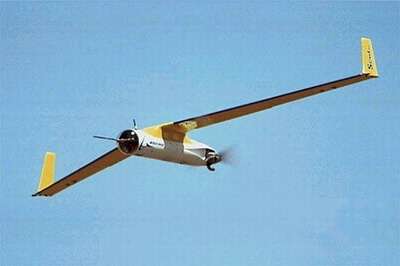
ScanEagle, a Boeing long-endurance unmanned aerial vehicle, successfully made its first autonomous flight Wednesday at the company's Boardman test facility in eastern Oregon. The UAV, built by The Insitu Group, took off via a pneumatic catapult and flew a pre-programmed course at a maximum altitude of 1,500 feet.

During the 45-minute flight, ScanEagle completed a number of test points using the Global Positioning System. The test team also demonstrated the ability to make real-time updates to the flight plan from the ground station. The UAV was retrieved using the patented SkyHook technique, in which the ScanEagle catches a rope hanging from a 30-foot-high pole.

"ScanEagle's milestone autonomous flight is a great example of the breadth of projects of our Unmanned Systems  organization," said Charlie Guthrie, Boeing Unmanned Systems director of rapid prototyping and advanced concepts. "We are melding Insitu's expertise and unique capabilities with the best of Boeing to provide an autonomous, low-cost, long-endurance UAV for a wide range of potential customers.

"Boeing has the proven expertise in all the areas essential to success in the unmanned market, and we foresee both commercial and military applications for this type of small, low-cost, long-endurance platform."

The four-foot long vehicle, which has a 10-foot wingspan and can fly up to 68 knots, was built using systems automation, integration, communications and payload technologies applicable to a variety of Boeing unmanned systems.

In February 2002, Boeing signed a 15-month agreement with Insitu to develop the ScanEagle UAV ("New UAV From Boeing, Insitu").

ScanEagle is based on Insitu's Seascan aircraft, a variant of which made the first UAV transatlantic flight, a 2,000-mile trip from Newfoundland to Scotland that used only 1.5 gallons of gasoline.

FMI: www.boeing.com

Advertisement

More News

Aero-News: Quote of the Day (12.09.25)

“We respectfully call on the City of Mesa to: 1. Withdraw the landing fee proposal immediately 2. Engage with the aviation community before making decisions that impact safet>[...]

ANN's Daily Aero-Term (12.09.25): High Speed Taxiway

High Speed Taxiway A long radius taxiway designed and provided with lighting or marking to define the path of aircraft, traveling at high speed (up to 60 knots), from the runway ce>[...]

ANN's Daily Aero-Linx (12.09.25)

Aero Linx: International Federation of Airworthiness (IFA) IFA uniquely combines together all those with responsibility for policies, principles and practices concerned with the co>[...]

NTSB Final Report: Diamond Aircraft Ind Inc DA20C1 (A1); Robinson Helicopter R44

Controller’s Expectation That VW02 Would Have Departed Sooner Led To An Inadequate Scan And Loss Of Situational Awareness Analysis: A Robinson R-44 helicopter N744AF, VW02 (V>[...]

ANN FAQ: Q&A 101

A Few Questions AND Answers To Help You Get MORE Out of ANN! 1) I forgot my password. How do I find it? 1) Easy... click here and give us your e-mail address--we'll send it to you >[...]

blog comments powered by Disqus



Advertisement

Advertisement

Podcasts

Advertisement

© 2007 - 2025 Web Development & Design by Pauli Systems, LC

