
EU Team Working On Hypersonic Airliner | Aero-News Network
Aero-News Network
RSS icon RSS feed
podcast icon MP3 podcast
Subscribe Aero-News e-mail Newsletter Subscribe

Airborne Unlimited -- Most Recent Daily Episodes

Episode Date

Airborne-Monday

Airborne-Tuesday

Airborne-Wednesday Airborne-Thursday

Airborne-Friday

Airborne On YouTube

Airborne-Unlimited-12.01.25

AirborneNextGen-
12.02.25

Airborne-Unlimited-12.03.25

Airborne-FltTraining-12.04.25

AirborneUnlimited-12.05.25

AFE 2025 LIVE MOSAIC Town Hall (Archived): www.airborne-live.net

Thu, Feb 07, 2008

EU Team Working On Hypersonic Airliner

A2 Would Hit Mach 5 Over Ocean

The European Union’s Long-Term Advanced Propulsion Concepts and Technologies (LAPCAT) project has Mach 5 flight potential within 25 years. Part of the EU’s research programs developed in 2002, Reaction Engines Limited will be partially funded for their work involving the hypersonic engine.

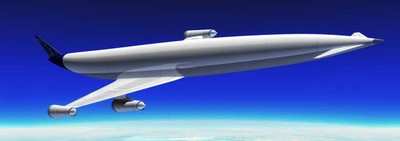
Conceptual design of the sleek A2 airliner proposes long distance flights across continents and oceans -- which currently take more than 20 hours -- would be reduced to less than five.

"The A2 is designed to leave Brussels international airport, fly quietly and subsonically out into the north Atlantic at Mach 0.9 before reaching Mach 5 across the North Pole and heading over the Pacific to Australia," LAPCAT chief Alan Bond told The Guardian Daily.

The A2 plane is designed with the Scimitar engine in mind, estimating a passenger load of 300 and distance capabilities of 20,000 km non-stop. The vehicle proposed is configured to attain the appropriate supersonic lift/drag ratio currently set as efficient standards for commercial operation. The propulsion systems involved would protect the aircraft as it transitions from take-off and subsonic continental speeds to the upwards of hypersonic Mach 5 speeds.

According to Reaction Engines, their Scimitar powerplant is a "precooled engine concept which exploits the unique thermodynamic properties of liquid hydrogen."

Shifting away from jet fuel to use the thermodynamic properties of liquid hydrogen means less of a carbon footprint, but more research and development to make it happen.

FMI: www.reactionengines.co.uk/lapcat.html

Advertisement

More News

ANN's Daily Aero-Term (12.04.25): Cooperative Surveillance

Cooperative Surveillance Any surveillance system, such as secondary surveillance radar (SSR), wide-area multilateration (WAM), or ADS-B, that is dependent upon the presence of cert>[...]

ANN's Daily Aero-Linx (12.04.25)

Aero Linx: OX5 Aviation Pioneers Incorporated in 1955 as a Pa 501 (c)(3) Not for Profit Corporation, the OX5 Aviation Pioneers is dedicated to bringing before the public the accomp>[...]

NTSB Prelim: Extra Flugzeugproduktions EA 300/SC

The Pilot Appeared To Regain Control After Six Rotations And Attempted To “Fly Out” Inverted But Had Insufficient Altitude On November 8, 2025, at 1038 eastern standard>[...]

Classic Aero-TV: The Bally Bomber - The All Time Ultimate Warbird Replica?

From 2018 (YouTube Edition): Aero-News Talks With The Airplane's Builder One of the many unique airplanes at AirVenture 2018 was a 1/3-scale B-17 bomber built by Jack Bally, who ta>[...]

ANN's Daily Aero-Linx (12.05.25)

Aero Linx: Society of U.S. Army Flight Surgeons (SoUSAFS) The Society of US Army Flight Surgeons (SoUSAFS) serves to advance the science and art of Aerospace Medicine and its allie>[...]

blog comments powered by Disqus



Advertisement

Advertisement

Podcasts

Advertisement

© 2007 - 2025 Web Development & Design by Pauli Systems, LC

