

DOT Report Proves AOPA’s Point: Weather, Airlines Cause Delays | Aero-News Network
Aero-News Network
RSS icon RSS feed
podcast icon MP3 podcast
Subscribe Aero-News e-mail Newsletter Subscribe

Airborne Unlimited -- Most Recent Daily Episodes

Episode Date

Airborne-Monday

Airborne-Tuesday

Airborne-Wednesday Airborne-Thursday

Airborne-Friday

Airborne On YouTube

Airborne-Unlimited-12.08.25

AirborneNextGen-
12.09.25

Airborne-Unlimited-12.10.25

Airborne-AffordableFlyers-12.11.25

AirborneUnlimited-12.05.25

AFE 2025 LIVE MOSAIC Town Hall (Archived): www.airborne-live.net

Sun, Aug 12, 2007

DOT Report Proves AOPA’s Point: Weather, Airlines Cause Delays

AOPA notes that the DOT reported this week that airline flight delays in June were worse than either May or June of last year. The airlines jumped on the news to again claim that it is an outdated air traffic control system and an “unfair” funding system that's responsible.

“The facts clearly show that the airlines’ own scheduling practices are a major cause of the problems,” said Aircraft Owners and Pilots Association (AOPA) President Phil Boyer. “And they can’t expect ATC modernization to cure all ills.”

AOPA supports the House FAA funding bill, H.R.2881, which provides funding for needed modernization of the air traffic control system through a proven system of aviation excise taxes.

The Bureau of Transportation Statistics (BTS) data shows the major causes of airline delays are weather and scheduling. And as AOPA has said before, tinkering with the aviation tax system and building NextGen (the air traffic modernization program) are still not going to allow airliners to penetrate a line of thunderstorms or occupy the same spot at the same time on a runway or taxiway.

More than 40 percent of airline delays are attributed to weather, according to the BTS. Looking at another data set, you see that the air carriers themselves are responsible for more than 25 percent of their delays through things they can control (maintenance or crew problems, baggage loading, fueling, etc.).

The issue of the airlines scheduling more flights than the airport can handle is a little more difficult to tease out of the BTS statistics. More than 28 percent of airline flight delays are attributed to “national aviation system (NAS) delays.”

But that’s a big pot. Included in the NAS category are delays due to non-extreme weather conditions, airport operations, heavy traffic volume, and air traffic control.

So if Airline X can’t push back and taxi out when it’s scheduled to because there are already too many scheduled flights trying to depart, it will be classified as an NAS delay. And it’s the airlines themselves that determine how they are going to classify and report a delayed flight.

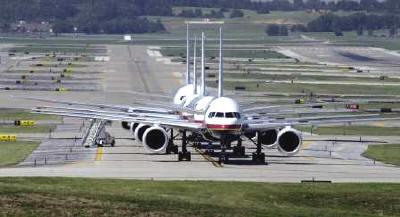
But AOPA analyzed the June airline schedules at all of the major airports. And at 17 out of 35 hub airports, the airlines have scheduled more flights during their daily “pushes” than the airports can handle in instrument weather conditions. It doesn’t take a thunderstorm to delay flights all across the country. Just have visibility drop below three miles or the ceiling below 1,000 feet at one of these 17 major airports and flights will be delayed.

Some of the worst airports for overscheduled airline flights include Chicago O'Hare, Atlanta Hartsfield, Newark, John F. Kennedy, Minneapolis-St. Paul, Salt Lake City, San Francisco, and Las Vegas McCarran.

FMI: www.aopa.org

Advertisement

More News

Aero-News: Quote of the Day (12.09.25)

“We respectfully call on the City of Mesa to: 1. Withdraw the landing fee proposal immediately 2. Engage with the aviation community before making decisions that impact safet>[...]

ANN's Daily Aero-Term (12.09.25): High Speed Taxiway

High Speed Taxiway A long radius taxiway designed and provided with lighting or marking to define the path of aircraft, traveling at high speed (up to 60 knots), from the runway ce>[...]

ANN's Daily Aero-Linx (12.09.25)

Aero Linx: International Federation of Airworthiness (IFA) IFA uniquely combines together all those with responsibility for policies, principles and practices concerned with the co>[...]

NTSB Final Report: Diamond Aircraft Ind Inc DA20C1 (A1); Robinson Helicopter R44

Controller’s Expectation That VW02 Would Have Departed Sooner Led To An Inadequate Scan And Loss Of Situational Awareness Analysis: A Robinson R-44 helicopter N744AF, VW02 (V>[...]

ANN FAQ: Q&A 101

A Few Questions AND Answers To Help You Get MORE Out of ANN! 1) I forgot my password. How do I find it? 1) Easy... click here and give us your e-mail address--we'll send it to you >[...]

blog comments powered by Disqus



Advertisement

Advertisement

Podcasts

Advertisement

© 2007 - 2025 Web Development & Design by Pauli Systems, LC

