

ISS Makes Room... Japanese Resupply Ship Departs Next Week | Aero-News Network
Aero-News Network
RSS icon RSS feed
podcast icon MP3 podcast
Subscribe Aero-News e-mail Newsletter Subscribe

Airborne Unlimited -- Most Recent Daily Episodes

Episode Date

Airborne-Monday

Airborne-Tuesday

Airborne-Wednesday Airborne-Thursday

Airborne-Friday

Airborne On YouTube

Airborne-Unlimited-12.08.25

AirborneNextGen-
12.09.25

Airborne-Unlimited-12.10.25

Airborne-AffordableFlyers-12.11.25

AirborneUnlimited-12.12.25

AFE 2025 LIVE MOSAIC Town Hall (Archived): www.airborne-live.net

Wed, Aug 12, 2020

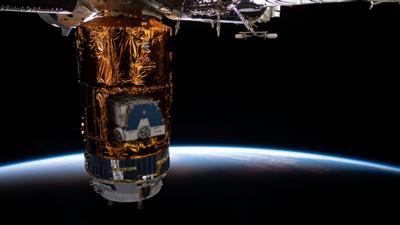
ISS Makes Room... Japanese Resupply Ship Departs Next Week

The HTV-9 Delivered Four Tons Of Gear On May 25

A Japanese resupply ship will depart the International Space Station next week after nearly three months attached to the orbital lab. Meanwhile, the Expedition 63 crew continued a variety of science operations.

JAXA, the Japan Aerospace Exploration Agency, announced Tuesday, Aug. 18, as the release date for its H-II Transfer Vehicle-9 (HTV-9) cargo craft. Ground controllers will remotely control the Canadarm2 robotic arm to grapple and remove the HTV-9 from the Harmony module. Commander Chris Cassidy of NASA will command the Canadarm2 to release the cargo craft into space completing an 85-day station mission. The HTV-9 will orbit Earth on its own for two more days and reenter the atmosphere above the South Pacific for a fiery, but safe demise.

The HTV-9 delivered four tons of gear on May 25 that included the new Space Frontier Studio for live broadcasts inside Japan’s Kibo laboratory module. Cassidy set up the live-streaming hardware today for an event highlighting science activities inside Kibo.

Cassidy also completed fluid research work that took place inside the U.S. Destiny laboratory module’s Microgravity Science Glovebox. The veteran astronaut disconnected, took apart and stowed the hardware that investigated water droplet behavior in microgravity. Results may promote water conservation and improve water pressure for Earth and space systems.

Cosmonaut Anatoly Ivanishin continued working on a long-running Earth observation study on the Russian side the station. That experiment is helping scientists monitor and forecast natural and man-made catastrophes around the world.

Fellow cosmonaut and flight engineer Ivan Vagner worked during the morning testing broadband video communications gear. The first-time space flyer then spent the rest of the afternoon servicing the ventilation subsystem in the Zvezda service module.

FMI: www.nasa.gov

Advertisement

More News

Aero-News: Quote of the Day (12.11.25)

"The owners envisioned something modern and distinctive, yet deeply meaningful. We collaborated closely to refine the flag design so it complemented the aircraft’s contours w>[...]

ANN's Daily Aero-Term (12.11.25): Nonradar Arrival

Nonradar Arrival An aircraft arriving at an airport without radar service or at an airport served by a radar facility and radar contact has not been established or has been termina>[...]

Classic Aero-TV: David Uhl and the Lofty Art of Aircraft Portraiture

From 2022 (YouTube Edition): Still Life with Verve David Uhl was born into a family of engineers and artists—a backdrop conducive to his gleaning a keen appreciation for the >[...]

Airborne-NextGen 12.09.25: Amazon Crash, China Rocket Accident, UAV Black Hawk

Also: Electra Goes Military, Miami Air Taxi, Hypersonics Lab, MagniX HeliStrom Amazon’s Prime Air drones are back in the spotlight after one of its newest MK30 delivery drone>[...]

Airborne 12.05.25: Thunderbird Ejects, Lost Air india 737, Dynon Update

Also: Trailblazing Aviator Betty Stewart, Wind Farm Scrutiny, Chatham Ban Overturned, Airbus Shares Dive A Thunderbird pilot, ID'ed alternately as Thunderbird 5 or Thunderbird 6, (>[...]

blog comments powered by Disqus



Advertisement

Advertisement

Podcasts

Advertisement

© 2007 - 2025 Web Development & Design by Pauli Systems, LC

