Fri, Sep 13, 2013
Aim Is To Protect Cockpits Of Commercial Aircraft
U.S. Senator Bob Casey (D-PA) has introduced the Saracini Aviation Safety Act of 2013 which would require each commercial aircraft to install a barrier, other than the cockpit door, to prevent access to the flight deck of an aircraft. The legislation is named after Bucks County resident Captain Victor Saracini who piloted United Flight 175 when it was hijacked by terrorists and flown into the World Trade Center. While cockpit doors are currently reinforced, a secondary barrier will protect passengers and crew during times in flights when cockpit doors are opened. The bill has been introduced in the House of Representatives by Congressman Michael Fitzpatrick (R-PA) and has 45 bipartisan cosponsors. The bill is also endorsed by the Airline Pilots Association, Allied Pilots Association and the Federal Law Enforcement Officers Association.
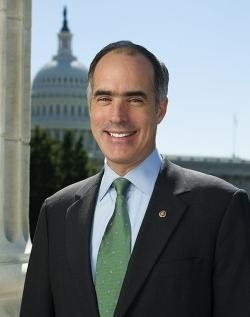
“We’ve made progress on airline safety in the years since September 11th 2001 but there are still additional common-sense steps we can take better protect passengers and flight crew,” Senator Casey said. “There’s no way to fully and completely honor the extraordinary courage of Captain Saracini. He gave the full measure of his life for our nation, and his wife, Ellen, and his family have worked tirelessly in the years since to increase airline safety. I’m urging Congress to pass this legislation to make further improvements to airline safety.”
In the aftermath of September 11th, Congress mandated the installation of reinforced cockpit doors, and the FAA issued regulations that stated that these reinforced doors should remain locked while closed. While this is a step in the right direction, these doors are often opened and closed several times during flights, putting airline pilots, crew, and passengers at risk. Due to budget cuts and sequestration, many of the federal programs designed to increase aviation safety, such as the Federal Flight Deck Officer program, are facing funding shortages. These factors show that our airlines are still vulnerable to potential terrorist attacks.
The Saracini Aviation Safety Act would address this problem by requiring each commercial aircraft to install a barrier, other than the cockpit door, to prevent access to the flight deck of an aircraft. It would also require that the barriers remain locked when the aircraft is in flight and the cockpit door is open. Lastly, it would give pilots of planes without cockpit doors, discretion on when they would like to lock the barrier during flight. This would provide a cost-effective, safe way to have additional security for our nation’s pilots, airlines, and passengers.
A secondary cockpit barrier is a light weight wire-mesh gate installed between the passenger cabin and cockpit door that is locked into place and blocks access to the flight deck. In 2003, a voluntary airline industry movement toward adopting secondary barriers began, but deployment of the devices waned. The barriers provide significantly more security to airline companies, their employees, and passengers. A 2007 study conducted at the request of the Airline Pilots Association International and the airline industry concluded that secondary cockpit barrier doors are the most cost-effective, efficient, and safest way to protect the cockpit.
Similar legislation was previously introduced in the U.S. House of Representatives.
More News
Aero Linx: Commercial Aviation Safety Team (CAST) Founded in 1997, the Commercial Aviation Safety Team (USCAST) has developed an integrated, data-driven strategy to reduce the comm>[...]
Land And Hold Short Operations Operations that include simultaneous takeoffs and landings and/or simultaneous landings when a landing aircraft is able and is instructed by the cont>[...]
We're Everywhere... Thanks To You! Even with the vast resources and incredibly far-reaching scope of the Aero-News Network, every now and then a story that should be reported on sl>[...]
Pilot’s Inadvertent Use Of The Landing Gear Control Handle Instead Of The Flaps Selector Switch During The Landing Rollout Analysis: The pilot reported that during the landin>[...]
Also: Cosmonaut Kicked Out, Airbus Scales Back, AF Silver Star, Russian A-60 Clobbered A Samaritan’s Purse humanitarian flight was hijacked on Tuesday, December 2, while atte>[...]



 ANN's Daily Aero-Linx (12.12.25)


 See All