
Gaia Spreads Its Wings | Aero-News Network
Aero-News Network
RSS icon RSS feed
podcast icon MP3 podcast
Subscribe Aero-News e-mail Newsletter Subscribe

Airborne Unlimited -- Most Recent Daily Episodes

Episode Date

Airborne-Monday

Airborne-Tuesday

Airborne-Wednesday Airborne-Thursday

Airborne-Friday

Airborne On YouTube

Airborne-Unlimited-12.08.25

AirborneNextGen-
12.09.25

Airborne-Unlimited-12.10.25

Airborne-AffordableFlyers-12.11.25

AirborneUnlimited-12.05.25

AFE 2025 LIVE MOSAIC Town Hall (Archived): www.airborne-live.net

Mon, Dec 12, 2011

Gaia Spreads Its Wings

European Probe's Sun Shield Deployed For The First Time

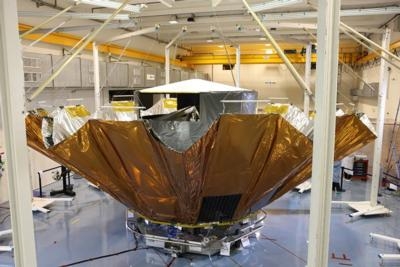
ESA's Gaia star-mapper has passed a critical test ahead of its launch in 2013: the spacecraft's sunshield has been deployed for the first time. Gaia's sunshield is an essential component of the mission. It keeps Gaia in shadow, maintaining the scientific instruments at a constant temperature of around -110 degrees centigrade.

ESA Photo

The sunshield is about 10 m across, which is too large for the launch vehicle fairing, so it has been built with a dozen folding panels that will be deployed after launch. Since the sunshield is designed for the weightlessness of space, it cannot support its own weight on Earth. So, during this test at Astrium in Toulouse, France, support cables and counterweights simulated weightless conditions and provided a realistic trial.

During its expected lifetime of five years, Gaia will take a census of a billion stars - roughly 1% of all of the stars in our Galaxy. It will observe each star about 70 times, each time recording its brightness, colour and, most importantly, its position. By comparing Gaia's series of exquisite observations, astronomers will precisely measure the apparent movement of each star across the heavens, enabling them to determine its distance and true motion through space. The unprecedented results will allow astronomers to trace the history of the Milky Way.

Before the 2013 launch, some of the solar array panels needed to generate power will be fixed to the sunshield. The rest will be placed on the bottom of the spacecraft.

FMI: www.esa.int

Advertisement

More News

Aero-News: Quote of the Day (12.09.25)

“We respectfully call on the City of Mesa to: 1. Withdraw the landing fee proposal immediately 2. Engage with the aviation community before making decisions that impact safet>[...]

ANN's Daily Aero-Term (12.09.25): High Speed Taxiway

High Speed Taxiway A long radius taxiway designed and provided with lighting or marking to define the path of aircraft, traveling at high speed (up to 60 knots), from the runway ce>[...]

ANN's Daily Aero-Linx (12.09.25)

Aero Linx: International Federation of Airworthiness (IFA) IFA uniquely combines together all those with responsibility for policies, principles and practices concerned with the co>[...]

NTSB Final Report: Diamond Aircraft Ind Inc DA20C1 (A1); Robinson Helicopter R44

Controller’s Expectation That VW02 Would Have Departed Sooner Led To An Inadequate Scan And Loss Of Situational Awareness Analysis: A Robinson R-44 helicopter N744AF, VW02 (V>[...]

ANN FAQ: Q&A 101

A Few Questions AND Answers To Help You Get MORE Out of ANN! 1) I forgot my password. How do I find it? 1) Easy... click here and give us your e-mail address--we'll send it to you >[...]

blog comments powered by Disqus



Advertisement

Advertisement

Podcasts

Advertisement

© 2007 - 2025 Web Development & Design by Pauli Systems, LC

