
Swirling Spirals At The North Pole Of Mars | Aero-News Network
Aero-News Network
RSS icon RSS feed
podcast icon MP3 podcast
Subscribe Aero-News e-mail Newsletter Subscribe

Airborne Unlimited -- Most Recent Daily Episodes

Episode Date

Airborne-Monday

Airborne-Tuesday

Airborne-Wednesday Airborne-Thursday

Airborne-Friday

Airborne On YouTube

Airborne-Unlimited-12.08.25

AirborneNextGen-
12.09.25

Airborne-Unlimited-12.10.25

Airborne-AffordableFlyers-12.11.25

AirborneUnlimited-12.05.25

AFE 2025 LIVE MOSAIC Town Hall (Archived): www.airborne-live.net

Sun, Feb 12, 2017

Swirling Spirals At The North Pole Of Mars

Images Captured By ESA's Mars Express

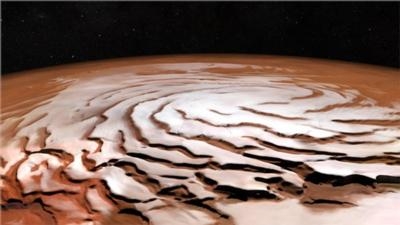
A new mosaic from ESA’s Mars Express shows off the Red Planet’s north polar ice cap and its distinctive dark spiralling troughs.

The mosaic was generated from 32 individual orbit ‘strips’ captured between 2004 and 2010, and covers an area of around a million square kilometres.

The ice cap is a permanent fixture, but in the winter season – as it is now in early 2017 – temperatures are cold enough for around 30 percent of the carbon dioxide in the planet’s atmosphere to precipitate onto the cap, adding a seasonal layer up to a meter thick. During the warmer summer months most of the carbon dioxide ice turns directly into gas and escapes into the atmosphere, leaving behind the water-ice layers.

Strong winds are thought to have played an important role in shaping the ice cap over time, blowing from the elevated centre towards its lower edges and twisted by the same Coriolis force that causes hurricanes to spiral on Earth.

One particularly prominent feature is a 310 mile-long, 1.2 mile-deep trench that almost cuts the cap in two. The plunging canyon, known as Chasma Boreale, is thought to be a relatively old feature, forming before the ice–dust spiral features, and seemingly growing deeper as new ice deposits built up around it.

Subsurface investigations by radar instruments onboard Mars Express and NASA’s Mars Reconnaissance Orbiter revealed that the ice cap is made up of many individual layers of ice and dust extending to a depth of around 2 km.

This presents a valuable record for the nature of how the planet’s climate has changed as its tilt and orbit varied over hundreds of thousands of years.

(Image provided with ESA news release)

FMI: www.esa.int

Advertisement

More News

Aero-News: Quote of the Day (12.09.25)

“We respectfully call on the City of Mesa to: 1. Withdraw the landing fee proposal immediately 2. Engage with the aviation community before making decisions that impact safet>[...]

ANN's Daily Aero-Term (12.09.25): High Speed Taxiway

High Speed Taxiway A long radius taxiway designed and provided with lighting or marking to define the path of aircraft, traveling at high speed (up to 60 knots), from the runway ce>[...]

ANN's Daily Aero-Linx (12.09.25)

Aero Linx: International Federation of Airworthiness (IFA) IFA uniquely combines together all those with responsibility for policies, principles and practices concerned with the co>[...]

NTSB Final Report: Diamond Aircraft Ind Inc DA20C1 (A1); Robinson Helicopter R44

Controller’s Expectation That VW02 Would Have Departed Sooner Led To An Inadequate Scan And Loss Of Situational Awareness Analysis: A Robinson R-44 helicopter N744AF, VW02 (V>[...]

ANN FAQ: Q&A 101

A Few Questions AND Answers To Help You Get MORE Out of ANN! 1) I forgot my password. How do I find it? 1) Easy... click here and give us your e-mail address--we'll send it to you >[...]

blog comments powered by Disqus



Advertisement

Advertisement

Podcasts

Advertisement

© 2007 - 2025 Web Development & Design by Pauli Systems, LC

