
ATSB Publishes Update On Cessna 210 Carry-Through Spar Failure | Aero-News Network
Aero-News Network
RSS icon RSS feed
podcast icon MP3 podcast
Subscribe Aero-News e-mail Newsletter Subscribe

Airborne Unlimited -- Most Recent Daily Episodes

Episode Date

Airborne-Monday

Airborne-Tuesday

Airborne-Wednesday Airborne-Thursday

Airborne-Friday

Airborne On YouTube

Airborne-Unlimited-12.08.25

AirborneNextGen-
12.09.25

Airborne-Unlimited-12.10.25

Airborne-AffordableFlyers-12.11.25

AirborneUnlimited-12.12.25

AFE 2025 LIVE MOSAIC Town Hall (Archived): www.airborne-live.net

Tue, Jun 11, 2019

ATSB Publishes Update On Cessna 210 Carry-Through Spar Failure

Airplane Impacted Terrain Near Mount Isa, Queensland, On May 26

The ATSB has published an update on its investigation into the collision with terrain of Cessna 210 VH-SUX near Mount Isa, Queensland, Australia on May 26.

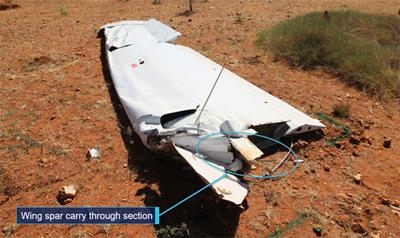
Evidence at the accident site indicated that the aircraft’s right wing had separated while in flight, resulting in a rapid loss of control and subsequent collision with terrain. The two pilots on board were fatally injured.

Subsequent technical examination confirmed the aircraft’s wing spar had fractured due to fatigue cracking, which reduced the spar’s structural integrity to the point where operational loads produced an overstress fracture.

“The ATSB has notified the Civil Aviation Safety Authority, the U.S. National Transportation Safety Board, the aircraft manufacturer and operator of the initial finding of fatigue cracking with the wing spar carry-through structure,” ATSB Executive Director Nat Nagy said. "The ATSB is working closely with those parties to ensure the continued safe operation of the the aircraft type."

The Cessna 210, which had been manufactured in 1976 and had accumulated over 12,000 flight hours, had been conducting a geological survey flight while flying at about 200 feet above ground level at the time of the accident.

The aircraft had been modified for geological survey work and had also been fitted with approved integral wing tip fuel tank and non-standard engine and propeller modifications.

“The ATSB notes that there is no evidence to indicate a connection between this accident and other recent investigations it has conducted involving this aircraft type,” Nagy said.

(Image provided with ATSB news release)

FMI: www.atsb.gov.au/publications/investigation_reports/2019/aair/ao-2019-026

Advertisement

More News

ANN's Daily Aero-Linx (12.12.25)

Aero Linx: Commercial Aviation Safety Team (CAST) Founded in 1997, the Commercial Aviation Safety Team (USCAST) has developed an integrated, data-driven strategy to reduce the comm>[...]

ANN's Daily Aero-Term (12.12.25): Land And Hold Short Operations

Land And Hold Short Operations Operations that include simultaneous takeoffs and landings and/or simultaneous landings when a landing aircraft is able and is instructed by the cont>[...]

ANN FAQ: How Do I Become A News Spy?

We're Everywhere... Thanks To You! Even with the vast resources and incredibly far-reaching scope of the Aero-News Network, every now and then a story that should be reported on sl>[...]

NTSB Final Report: Cirrus Design Corp SF50

Pilot’s Inadvertent Use Of The Landing Gear Control Handle Instead Of The Flaps Selector Switch During The Landing Rollout Analysis: The pilot reported that during the landin>[...]

Airborne 12.08.25: Samaritan’s Purse Hijack, FAA Med Relief, China Rocket Fail

Also: Cosmonaut Kicked Out, Airbus Scales Back, AF Silver Star, Russian A-60 Clobbered A Samaritan’s Purse humanitarian flight was hijacked on Tuesday, December 2, while atte>[...]

blog comments powered by Disqus



Advertisement

Advertisement

Podcasts

Advertisement

© 2007 - 2025 Web Development & Design by Pauli Systems, LC

