
FOAM-C: Airbus Now ‘Foaming’ On Board The International Space Station | Aero-News Network
Aero-News Network
RSS icon RSS feed
podcast icon MP3 podcast
Subscribe Aero-News e-mail Newsletter Subscribe

Airborne Unlimited -- Most Recent Daily Episodes

Episode Date

Airborne-Monday

Airborne-Tuesday

Airborne-Wednesday Airborne-Thursday

Airborne-Friday

Airborne On YouTube

Airborne-Unlimited-12.01.25

AirborneNextGen-
12.02.25

Airborne-Unlimited-12.03.25

Airborne-FltTraining-12.04.25

AirborneUnlimited-12.05.25

AFE 2025 LIVE MOSAIC Town Hall (Archived): www.airborne-live.net

Sat, Mar 07, 2020

FOAM-C: Airbus Now ‘Foaming’ On Board The International Space Station

Experiment Studies The Stability Of Foams Away From The Influence Of Earth’s Gravity

Airbus has sent a new fluid experiment, FOAM-C, to the International Space Station (ISS). FOAM-C, which was developed and manufactured for the European Space Agency (ESA), is scheduled to be activated this month by astronaut Jessica Meir, who has been on the ISS since September 2019.

The FOAM-C experiment studies the stability of foams away from the influence of Earth’s gravity. The scientists are interested in the behaviour of the foams at different liquid fraction and in particular around the point of un-jamming (transition from a solid-like to liquid-like structure), which can be studied only in microgravity.

In addition this experiment might provide useful insights for the manufacture, use and ageing behaviour of foams, which are utilised in a wide range of areas, including in cosmetics and personal-hygiene products, in the food industry, in cleaning products, sealing products and for firefighting.

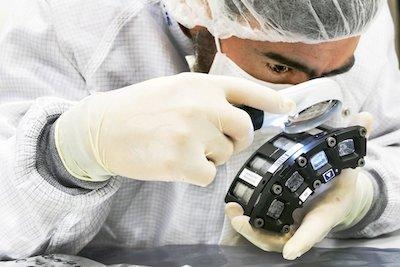
The FOAM-C experimental set-up comprises five segments with a total of 20 small test cells containing a variety of liquid mixtures. The Fluid Science Laboratory on the ISS Columbus module will automatically shake and analyse these mixtures using complex laser optics, highly sensitive photodiodes and high-resolution cameras that can take up to 10,000 images per second.

Each test cell weighs only 20 grams (0.7 ounces) and contains less than 2 cm³ (0.12 in³) of the liquid mixture, while each segment comprises four test cells and weighs a total of 320 grams (11 ounces).

(Image provided wit Airbus news release)

FMI: www.airbus.com

Advertisement

More News

ANN's Daily Aero-Term (12.04.25): Cooperative Surveillance

Cooperative Surveillance Any surveillance system, such as secondary surveillance radar (SSR), wide-area multilateration (WAM), or ADS-B, that is dependent upon the presence of cert>[...]

ANN's Daily Aero-Linx (12.04.25)

Aero Linx: OX5 Aviation Pioneers Incorporated in 1955 as a Pa 501 (c)(3) Not for Profit Corporation, the OX5 Aviation Pioneers is dedicated to bringing before the public the accomp>[...]

NTSB Prelim: Extra Flugzeugproduktions EA 300/SC

The Pilot Appeared To Regain Control After Six Rotations And Attempted To “Fly Out” Inverted But Had Insufficient Altitude On November 8, 2025, at 1038 eastern standard>[...]

Classic Aero-TV: The Bally Bomber - The All Time Ultimate Warbird Replica?

From 2018 (YouTube Edition): Aero-News Talks With The Airplane's Builder One of the many unique airplanes at AirVenture 2018 was a 1/3-scale B-17 bomber built by Jack Bally, who ta>[...]

ANN's Daily Aero-Linx (12.05.25)

Aero Linx: Society of U.S. Army Flight Surgeons (SoUSAFS) The Society of US Army Flight Surgeons (SoUSAFS) serves to advance the science and art of Aerospace Medicine and its allie>[...]

blog comments powered by Disqus



Advertisement

Advertisement

Podcasts

Advertisement

© 2007 - 2025 Web Development & Design by Pauli Systems, LC

