Aircraft Gathering Video, UV, And Thermal Image Data From Onboard Camera
Texas A&M University-Corpus Christi’s Lone Star Unmanned Aircraft Systems Center (LSUASC) is expanding operations, with test-flight missions this past week from an airport in Port Mansfield.
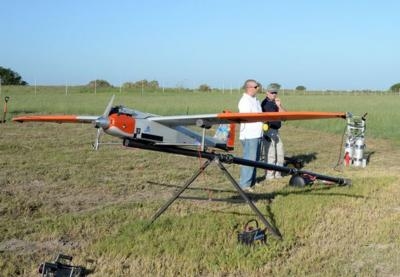
Researchers began a series of missions Monday, Oct. 6, with the University’s RS-16 unmanned aerial vehicle (UAV), and are expected to continue through Friday.
“Texas A&M University-Corpus Christi and the Lone Star UAS Center are excited to be expanding our operations and capacities for UAS testing for operation and development,” said Dr. Luis Cifuentes, Interim Executive Director of the Lone Star UAS Center and the University’s Vice President for Research, Commercialization and Outreach. “Now aircraft with landing gear that need a landing strip can test and fly with our center.
“We’re honored to be working closely with the FAA to address complex issues leading to safe UAS integration into the national airspace system. The FAA has given us the green light to develop our infrastructure as planned since October 2012 and to engage the UAS industry in developing solutions leading to safe integration.
“We have a plan and we’re sticking to it. Texas can be proud of its test site and the contributions our statewide team is making to the economy and higher-education research, development and commercialization.”
The RS-16 is the University’s largest UAV, with a wingspan of nearly 13 feet and a maximum weight of 85 pounds. It launches with a pneumatic catapult and lands on its belly.
The mission is gathering video, ultraviolet and thermal image data from an onboard multi-spectral camera for a private-sector company, the first non-University entity to test with the Lone Star UAS Center. The company and details of its testing are confidential.
The upcoming missions address several of the FAA research goals designed to safely integrate remotely piloted aircraft into the national airspace by 2015, including:
- Air traffic control and communications as it relates to the new range, including developing protocols for dealing with runway in use by piloted craft;
- Best practices for use of a chase plane that can more efficiently match speed and follow the UAV; and
- Continuation of refining process of ensuring air traffic control communications between UAV, ground control station and Mission Control Center in Corpus Christi.
During these missions, the UAV is monitored by a piloted aircraft as it flies. Regulations require that the drone remain under visual contact at all times.
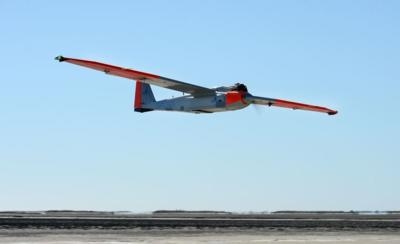
The University will file a report with the FAA, part of the requirements of test site operators.
Collecting this kind of aerial imagery is vital to research, business and safety. Areas of use for UAS are likely to include:
- Search-and rescue missions, surveying disaster areas or accident scenes;
- Mapping coastlines to observe changes over time; and
- Inventorying wildlife, habitats, agriculture and pipelines through remote areas.
Since 2011, the University has conducted regular flights of its RS-16. Previous missions launched from ranchland in Kenedy County.
Read more about the Lone Star UAS Center’s Port Mansfield range.
The Port Mansfield range, which is a 45-minute drive from Harlingen, Texas, is adjacent to another approved range south of Corpus Christi near Sarita, Texas, where the University regularly flies its 13-foot-wingspan RS-16.
The Lone Star UAS Center has proposed additional ranges west of Port Mansfield. See a map of the test ranges at lsuasc.tamucc.edu.
Since the test site designation in December, the Lone Star Center has received inquiries from more than 60 private-sector companies and other government agencies that want to test and research aircraft, software or other possible uses for unmanned aircraft, commonly referred to as drones.
While the test site designation does not come with federal funding, studies show an anticipated economic impact, once airspace is opened to UAS, would be about $6.5 billion and 8,256 jobs statewide from 2015 to 2025.
(Images provide by Texas A&M University)



 ANN's Daily Aero-Linx (12.12.25)


 See All